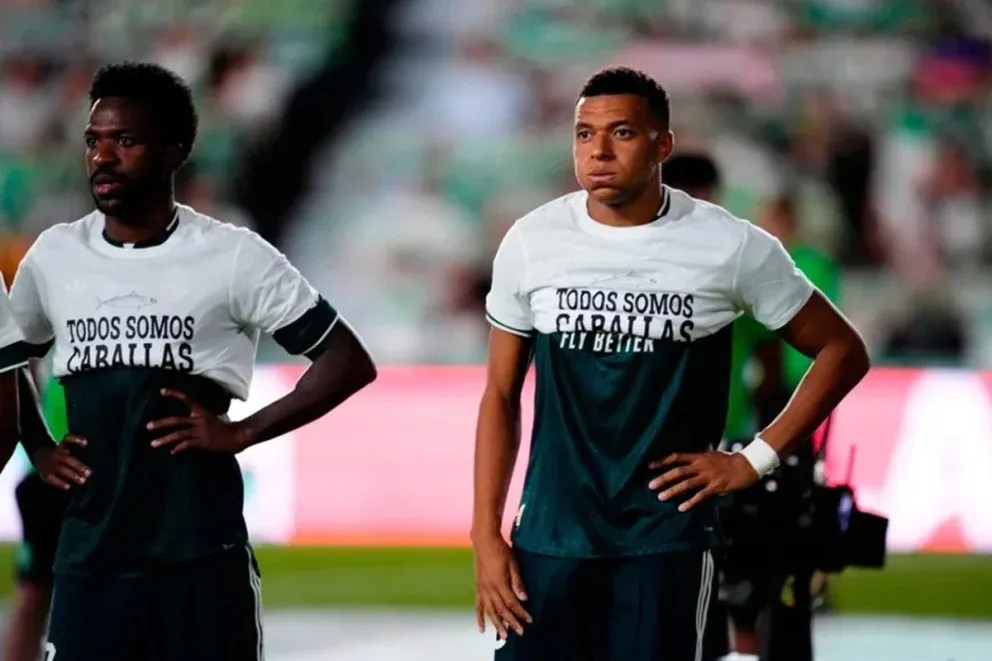
Kylian Mbappé, Vinícius Jr. and Ibrahima Konaté prompted controversy before Real Madrid’s La Liga victory over Elche after partially covering a message of support for Ceuta on pre-match shirts.
Before Tuesday’s fixture at the Martínez Valero Stadium, players from Real Madrid and Elche wore white T-shirts carrying the words “Todos somos caballas.” The phrase translates literally as “We are all mackerels” but uses a local nickname for the people of Ceuta, conveying solidarity with the Spanish territory in North Africa amid its ongoing migration crisis.
Mbappé, Vinícius and Konaté wore their shirts rolled up to the chest, partly obscuring the message. The rest of the Real Madrid and Elche players displayed the slogan normally before the match, which Real Madrid won 3–2.
The shirts had been approved by La Liga, Elche and Real Madrid and were introduced as a show of support for Ceuta, where local authorities have faced pressure after a surge in migrant arrivals from Morocco during the summer.
La Liga president Javier Tebas criticised the three players’ decision. “Putting it half on is the same as not wearing it,” he said, while a Real Madrid supporters’ group called for public apologies from Mbappé, Vinícius and Konaté.
Mbappé later explained that the gesture was not intended as a rejection of Ceuta or its residents. He said he wanted to express solidarity with people affected by the crisis on both sides of the border.
“The first thing I want to say is that I have complete solidarity with Ceuta and all the victims, because before being a player, I am human,” Mbappé told Diario AS.
“But I also wanted to make a gesture and spare a thought for all the immigrants who have lost their lives and who are also living in harsh conditions,” he added. “I have nothing against [the people of Ceuta], and I support them 100% in my thoughts. But I also wanted to spare a thought for all the people who are suffering, because I do not want to prioritise one form of suffering over another.”
Real Madrid defended the players’ right to hold different views, while the episode widened a debate in Spain over migration, Ceuta’s relationship with Morocco and the role of footballers in political or humanitarian campaigns.