

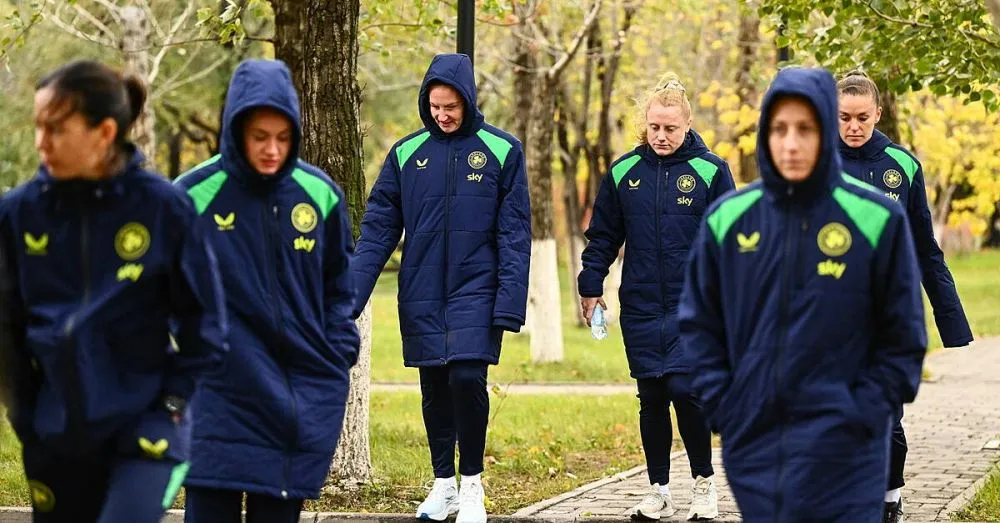
The Republic of Ireland’s path to the 2026 Women’s World Cup begins in the cold of Kazakhstan, where a first-leg victory over a 98th-ranked opponent will set the tone for a potential four-match odyssey to Brazil. Carla Ward’s side, ranked 21st in the world, enters Friday’s match at Astana Arena with no room for error. The stakes are clear: a sweep past Kazakhstan is non-negotiable, as the Irish must avoid bottoming out in their League A group to secure home advantage for the return leg—a critical tactical and psychological advantage in a playoff system designed to reward consistency.
Ward’s message is blunt and uncompromising. ‘My heart and my focus, I came here to try and get to a World Cup,’ she declared, framing the entire campaign around a singular objective. The words carry weight after a group-stage exit in 2023, where Ireland fell to Australia and Canada before drawing with Nigeria—a campaign that ended with unfulfilled potential. Now, with a playoff system that demands relentless performance, the Irish must prove they are more than a one-off surprise. The artificial pitch of Astana, where the first leg unfolds at noon Irish time, will test their adaptability, but Ward’s insistence on ‘blood, sweat, and tears’ suggests no shortcuts are acceptable.
The playoff structure itself is a labyrinth of elimination, where eight spots remain to be decided after the four direct qualifiers—Denmark, France, Germany, and Spain—have already secured their places. Ireland’s journey, if successful, would culminate in a two-legged final against either Belgium or Poland, teams with far greater collective experience. Yet the immediate challenge is Kazakhstan, a side that has yet to qualify for a major tournament. The 98-point gap in FIFA rankings is a statistical irrelevance compared to the on-field reality: Ireland must dictate tempo, exploit defensive vulnerabilities, and leave nothing to chance. Their unbeaten record at home in Cork offers a glimmer of confidence, but Ward’s refusal to take anything for granted underscores the gravity of the task ahead.
Beyond the immediate match, the implications stretch into March 2026, when the playoff semi-finals and finals will be decided in a single international window. Ireland’s seeding ensures they retain home advantage for both legs of their potential final, a strategic edge that could prove decisive against a more formidable opponent. The road is arduous, but Ward’s leadership and the team’s collective hunger for redemption after 2023 could turn this playoff into a statement of intent. For now, the focus is singular: a clean sheet in Astana, followed by the same discipline in Cork. Anything less risks leaving Brazil’s World Cup dreams in the cold—literally and figuratively.



