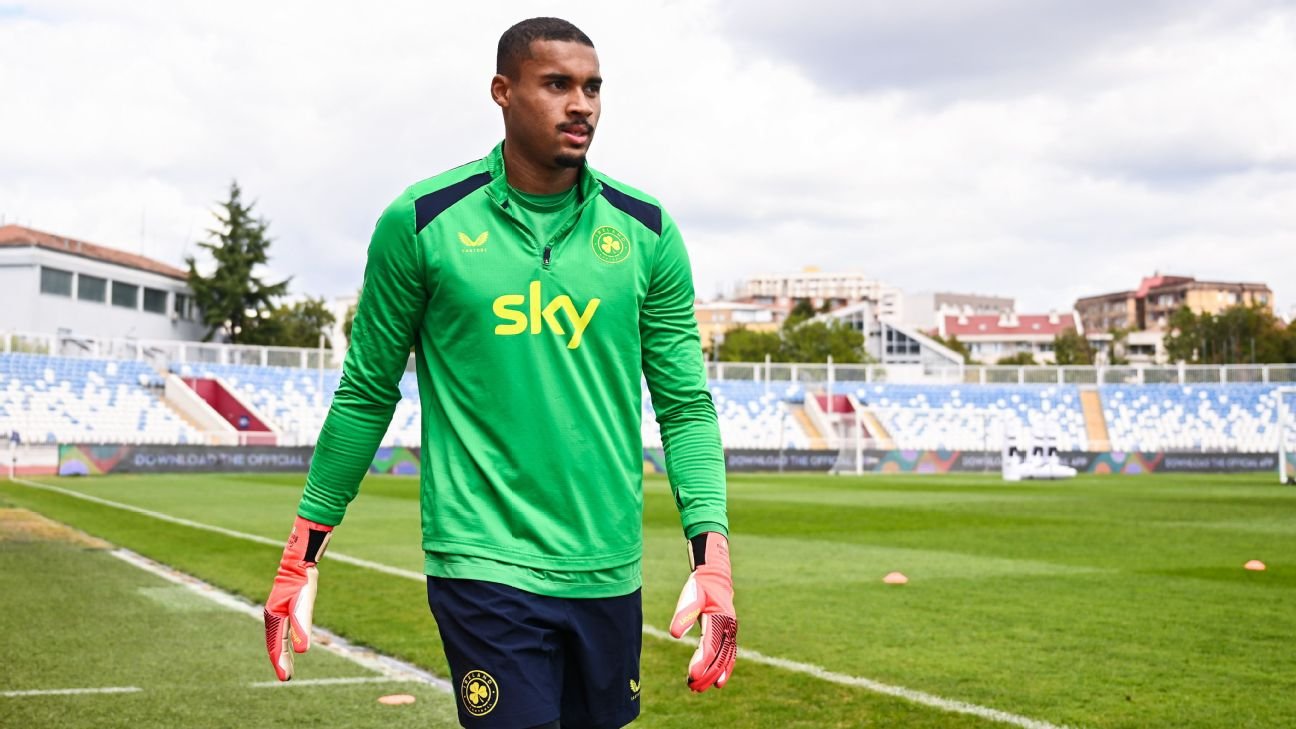
Goalkeeper Gavin Bazunu has become the first Republic of Ireland player to withdraw from the squad ahead of Sunday’s Nations League match against Israel, declaring his refusal to participate as a matter of principle.
In a statement posted on social media, Bazunu said he is “a man of strong faith” and that he feels “it would be wrong to participate in the upcoming fixtures against Israel,” adding that his decision is “based purely upon my personal belief that the killing of innocent people is wrong.”
He clarified that his stance is not directed at the Israeli people or the Jewish community, but against “the atrocities in the region.”
The fallout began when an unnamed player’s withdrawal forced an emergency squad meeting on Saturday, culminating in a 14–8 vote to proceed with the match.
Manager Heimir Hallgrímsson confirmed the decision, though he avoided direct criticism of Bazunu, instead framing the situation as a “difficult” internal debate.
The FAI’s earlier announcement—no tickets would be sold to Irish supporters—had already positioned the game as one of the most politically charged in the association’s history.
Yet the withdrawal of a key player, combined with the vote’s narrow margin, signals a squad fractured not just by principle, but by the weight of external pressure.
Bazunu’s refusal to compromise—despite the risk of UEFA penalties—has set a precedent, with other players now facing the same moral dilemma.
The political backdrop to this clash is undeniable.
Ireland’s Nations League group includes Israel, a fixture that has sparked boycott campaigns from fans, politicians and even broadcasters.
National broadcaster RTÉ’s decision to air the game without Irish commentary underscores the association’s attempt to distance itself from the controversy, though the FAI’s refusal to sell tickets to supporters has done little to quell criticism.
The match itself will proceed without pre-game rituals—no handshakes, no pennant exchange—further isolating the Irish side.
Bazunu’s stance, however, goes beyond protocol; it is a direct challenge to the neutrality of football in times of conflict, forcing players to weigh their personal convictions against the demands of national duty.
For Bazunu, the decision was never about football.
In his statement, he clarified that his opposition was not directed at the Israeli people but at the “atrocities in the region,” framing his withdrawal as an opportunity to “stand up for something bigger.”
His words carry weight in a moment where sports figures are increasingly expected to take a stance on geopolitical issues.
Yet the fallout extends beyond individual conscience.
The 14–8 vote suggests a squad divided, with some players prioritizing solidarity over principle.
The risk of UEFA penalties—financial or disciplinary—hangs over the team, but the real cost may be intangible: the erosion of trust among players who now must navigate a campaign overshadowed by moral ambiguity.
This is not the first time Ireland’s Nations League campaign has been politicized.
RTÉ’s decision to scale back its coverage of the fixtures—announced days before the Israel match—was a clear signal of the broadcaster’s unease.
Yet the withdrawal of a player, particularly a goalkeeper, amplifies the stakes.
Bazunu’s action has forced the FAI and the squad to confront uncomfortable questions: How far should athletes go in protest?
Can a team function when its members hold irreconcilable views?
And what does it mean for the integrity of football when national teams are drawn into conflicts beyond their control?
The answer may lie not in the result of Sunday’s match, but in how Ireland’s leadership navigates the aftermath—a test of principle, unity and the limits of sport in a fractured world.