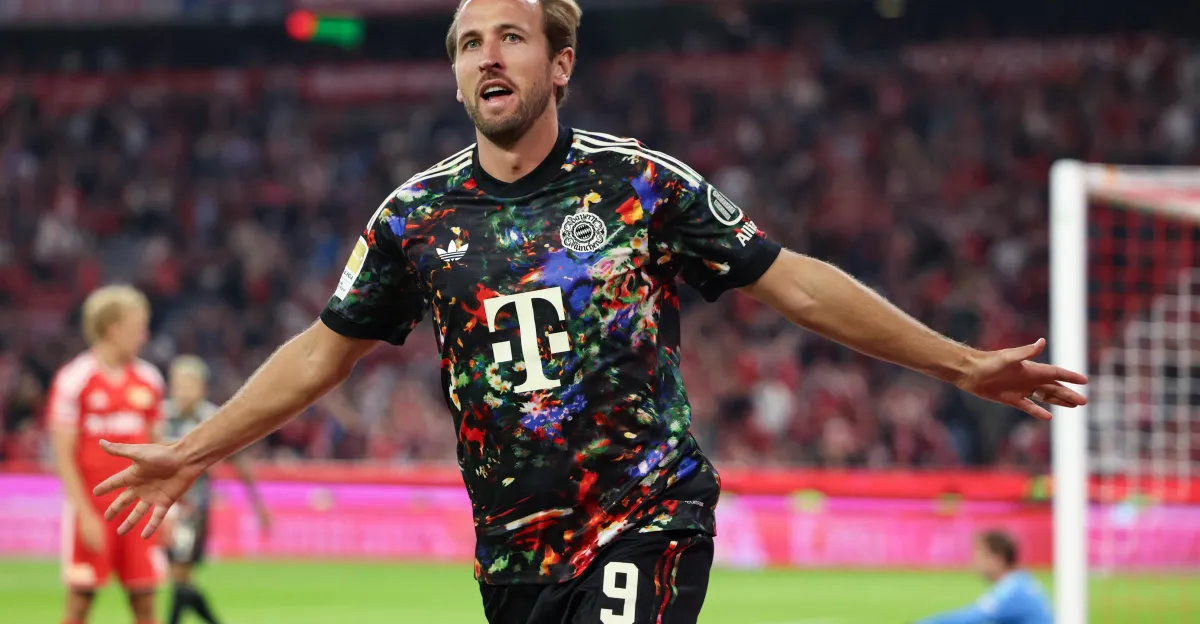
The Ballon d’Or debate has been settled, at least according to Bayern Munich’s president. Herbert Hainer, speaking with uncharacteristic bluntness, has declared Harry Kane the undisputed winner of this year’s award—an assertion backed by numbers so dominant they leave little room for debate. Kane’s 2025/26 campaign wasn’t just another stellar season; it was a historic run that redefined his legacy. With 73 competitive goals—second only to Gerd Müller’s legendary tally—Kane didn’t just dominate the Bundesliga; he redefined what’s possible in modern football. His 60 goals across the domestic league, DFB-Pokal, and Champions League, combined with a domestic double and a semifinal berth in the world’s elite club competition, paint a picture of a player operating at an entirely different level.
Hainer’s endorsement carries weight beyond mere rhetoric. As Bayern’s president, he isn’t just a cheerleader; he’s a decision-maker with a track record of shaping the club’s future. His statement—‘I don’t know what more you have to do to win the Ballon d’Or’—isn’t hyperbole. It’s a direct challenge to the award’s selectors, who have historically favored flair over firepower. Kane’s ability to deliver in the most high-pressure moments—whether it’s the Champions League knockout stages or the final whistle of the DFB-Pokal final—has been the defining trait of his Munich tenure. Even more telling is the club’s commitment to his future. Hainer’s recent comments about extending Kane’s contract, coupled with the striker’s own optimism about his stay in Bavaria, signal that this isn’t just a one-season blip. It’s the beginning of a new chapter, one where Kane’s status as Bayern’s all-time top scorer and a global icon is only set to grow.
Yet the Ballon d’Or is never won without controversy. Lamine Yamal’s meteoric rise has injected fresh energy into the debate, with the Barcelona prodigy’s dazzling performances and youthful promise making him a dark horse. Hainer acknowledged Yamal’s quality—‘a very good player with a great future’—but insisted that Kane’s *total* output last season sets him apart. The contrast is stark: Yamal’s brilliance is undeniable, but Kane’s *consistency* across all competitions, his leadership in a team that won everything, and his sheer dominance in front of goal make him the more complete candidate. The fact that Kane has avoided the self-promotion that often accompanies Ballon d’Or campaigns only adds to his authenticity. His quiet confidence—‘the Ballon d’Or isn’t in my hands’—resonates with fans who value humility in a player who has already rewritten the record books.
What’s most intriguing is how this moment aligns with Kane’s broader narrative. At 33, he’s defied the age-related decline that plagues many strikers, instead becoming Bayern’s most complete forward since the era of Müller and Beckenbauer. His ability to elevate teammates, his clinical finishing, and his mental resilience in big games make him not just a scorer, but a leader. If he wins the Ballon d’Or, he won’t just be England’s first since Owen; he’ll be the first Bayern player since Rummenigge to claim the trophy, cementing his place in the club’s pantheon. The award ceremony in London on October 26 will be the ultimate test of whether selectors prioritize *impact* over individual flair—a question Hainer’s endorsement has already answered.
For now, the focus remains on Kane’s final months at Bayern, where his contract negotiations loom as large as his scoring records. But one thing is certain: the case for his Ballon d’Or has never been stronger. The numbers don’t lie. The trophies don’t lie. And neither, it seems, does the man who signs the checks at Bayern Munich.