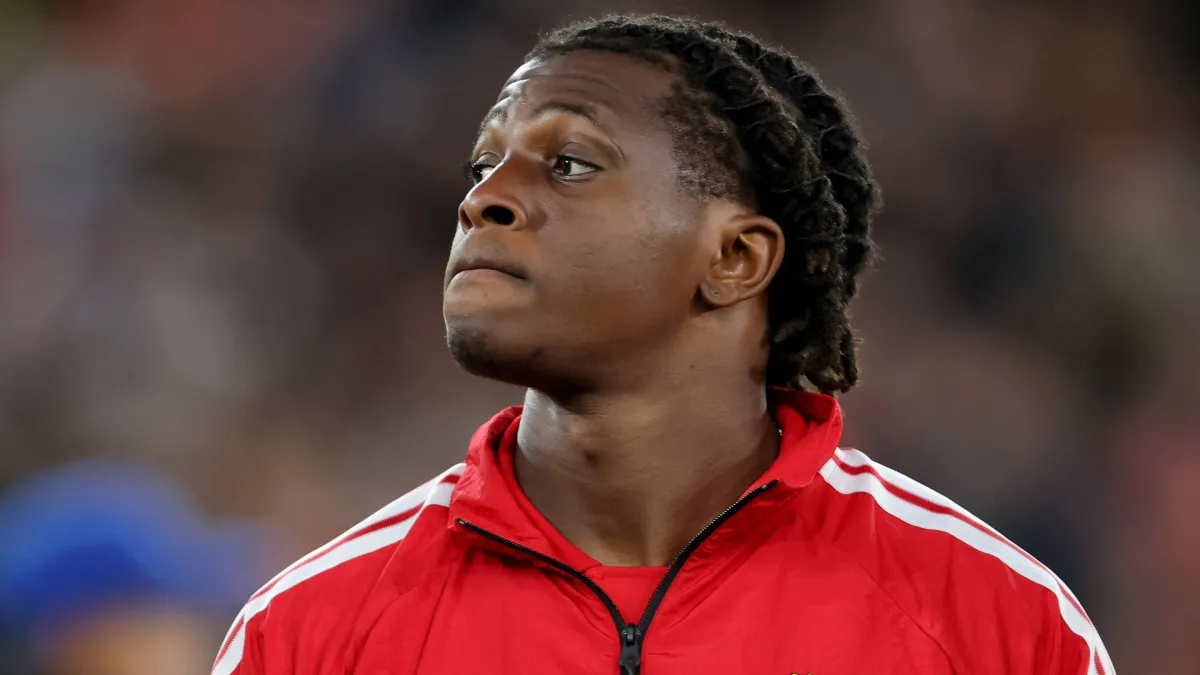
Manchester United’s tactical conundrum with Patrick Dorgu is no longer just a theoretical debate—it’s a pressing reality.
The 21-year-old Denmark international, who joined from Lecce in January 2025, has already made around 50 appearances across all competitions, scoring four goals and providing five assists.
Yet, his future at Old Trafford hangs on a single question: will he be a winger, a wing-back, or something in between?
His versatility is undeniable, but Carrick’s system demands precision—and Dorgu’s reluctance to commit to a single position risks leaving his own future in limbo.
Carrick has framed Dorgu’s return as an opportunity akin to a ‘new signing,’ praising his adaptability in both attack and defense.
The United boss has deployed him as a right winger for Denmark, where he scored a standout goal in the summer, yet his most recent minutes under Carrick have come as a left-sided attacker.
But the reality is that United’s defensive structure—particularly at left-back—now requires a more permanent solution.
Luke Shaw’s eventual departure looms, and Dorgu’s potential as a full-back, a role he excelled in under Ruben Amorim, could be the key to filling that void.
The problem? Dorgu himself has admitted he’d prefer ‘one set position’ to simplify his game.
That wish, however, could backfire if it limits his options in a squad where every player must be a solution to multiple problems.
The tactical implications stretch beyond Dorgu’s own development.
If he establishes himself as a full-back, United’s summer transfer strategy might pivot toward securing a left-footed attacking option to replace the defensive shift.
Conversely, if he remains a winger, his impact could be diluted in a front three that already features Bruno Fernandes and Marcus Rashford.
Carrick’s non-committal response—‘I wouldn’t want to pin him down’—reveals the uncertainty.
Yet, the manager’s words carry weight: Dorgu’s injury absence has forced United to adapt, and his return must be strategic.
The question isn’t just about Dorgu’s comfort—it’s about whether he can become the linchpin in a system that demands fluidity.
Dorgu’s international experience offers clues.
His ability to play off the right for Denmark suggests he thrives in attacking roles, but his wing-back tenure under Amorim proves he can also anchor defensively.
The challenge for Carrick is to integrate him seamlessly into a Premier League and Champions League campaign where every minute counts.
If Dorgu’s recovery is to be a catalyst, he must embrace the versatility that makes him valuable—or risk becoming another player whose potential is outstripped by indecision.
The clock is ticking. United’s summer window will arrive sooner than he thinks.