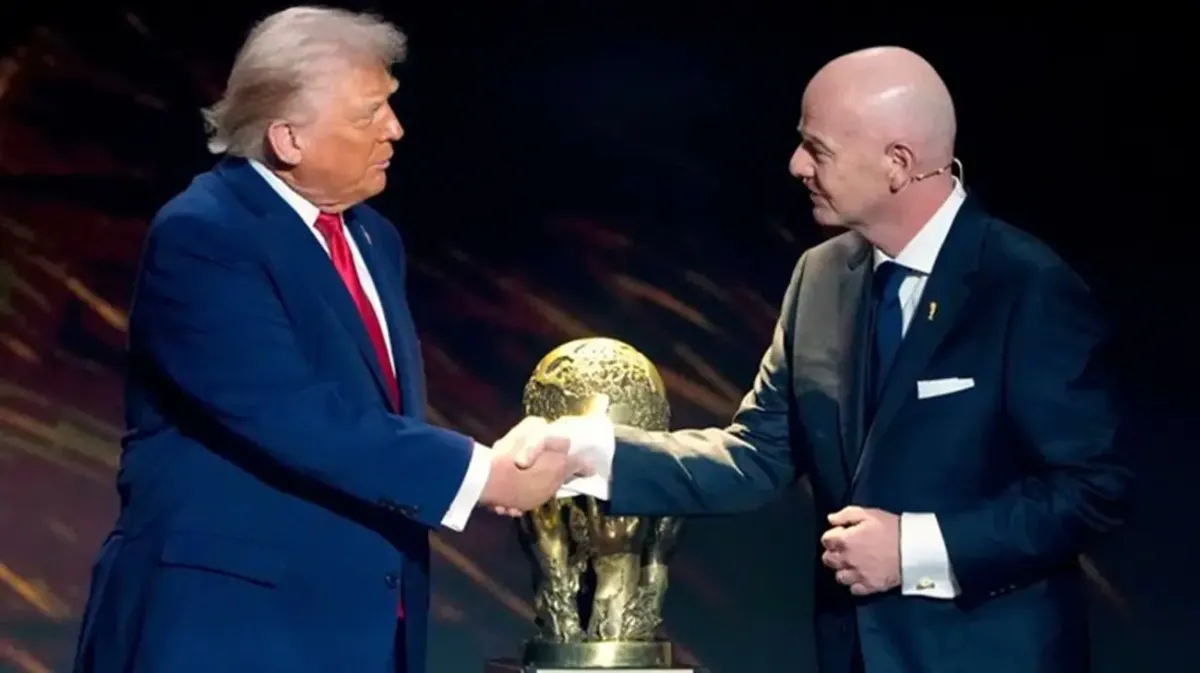
The Norwegian Football Federation has formally requested FIFA’s Governance Committee to investigate whether its internal oversight mechanisms failed during the 2026 World Cup, marking a direct challenge to the organization’s decision-making processes. At the heart of the complaint is the suspension of Folarin Balogun’s automatic one-match ban—a decision that sparked outrage after the U.S. striker’s red card in the tournament. The NFF’s intervention follows its earlier support for a broader ethical complaint against FIFA president Gianni Infantino, which accused him of violating political neutrality by awarding Donald Trump the inaugural FIFA Peace Prize without FIFA Council consultation.
The Norwegian federation’s latest move is framed as a demand for transparency, with its president, Lise Klaveness, explicitly linking the Balogun case to the broader inquiry into Infantino’s leadership. The complaint argues that the suspension of Balogun—who had been the U.S. team’s top scorer—was not only a tactical oversight but a symbolic failure of FIFA’s governance. The NFF’s request comes after FairSquare, a global advocacy group, initially filed the ethical complaint in December, which was later endorsed by 50 European Parliament members. The timing of the NFF’s intervention suggests a coordinated effort to pressure FIFA to address what critics describe as a pattern of institutional capture.
Beyond the Balogun case, the Norwegian federation’s submission raises questions about the broader integrity of FIFA’s decision-making during the 2026 World Cup draw. The awarding of the Peace Prize to Trump—without prior FIFA Council approval—has been a recurring point of contention, with critics arguing it undermined FIFA’s neutrality. The NFF’s formal challenge now places additional pressure on FIFA to either defend its processes or face a deeper institutional review. The request to the Governance Committee specifically asks whether FIFA’s internal controls were adequate, a question that could have far-reaching implications for future tournaments.
The escalation follows a broader trend of scrutiny against Infantino, who has faced repeated allegations of political interference and lack of transparency. The Norwegian federation’s decision to push for an independent review signals that the controversy over the 2026 World Cup is far from resolved. With the International Olympic Committee reportedly considering its own investigation into Infantino’s tenure, the pressure on FIFA’s leadership appears to be intensifying. The outcome of the NFF’s request could set a precedent for how FIFA handles future governance disputes, particularly in high-profile tournaments.