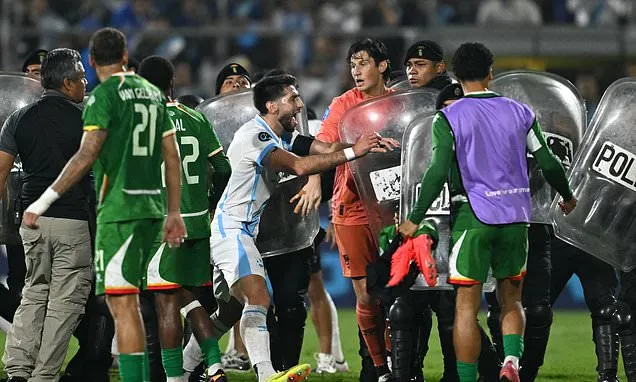
The Nations League match between Suriname and Guatemala on October 3, 2026, descended into violence after a 96th-minute winner by Matthew Evans secured a 1-0 victory for the Central American side. What began as a tense encounter quickly spiraled into a mass brawl near the pitch perimeter, forcing riot police to rush onto the field to restore order. Witnesses reported that the altercation erupted after Suriname players and fans accused Guatemala of racist conduct during the match, with tensions escalating as the final whistle approached.
The incident unfolded in the final minutes of the game, with Evans’ late goal sparking immediate backlash from Suriname’s squad. Players reportedly stormed the tunnel and approached Guatemala’s dugout, demanding an explanation for what they described as ‘systematic racism’ directed at their team. The confrontation escalated into a physical altercation, with security personnel struggling to contain the situation before riot police intervened. The match’s final moments were overshadowed by the chaos, leaving both teams’ reputations—and the Nations League’s credibility—under severe scrutiny.
FIFA has since been urged to take urgent action following the incident. Suriname’s delegation, led by their head coach, publicly condemned the ‘racist behavior’ they claimed was exhibited by Guatemala’s players and officials throughout the match. The accusation came after a series of similar incidents in recent months, including a high-profile Nations League clash where Ireland’s staff reported an alleged verbal altercation with an Israeli player. While no formal disciplinary measures have been announced, the escalating tensions signal a growing crisis in international football’s approach to on-field conduct and fan safety.
The violence at the Suriname-Guatemala match is not an isolated incident. Earlier this year, the Africa Cup of Nations final between Senegal and Morocco saw players walk off the pitch in protest after a controversial penalty decision, with riot police required to secure the stadium before extra time resumed. Such incidents highlight a broader trend of escalating unrest at major tournaments, where security protocols have struggled to keep pace with fan and player frustration. The Nations League, already facing criticism for its scheduling and competitive balance, now finds itself at the center of a growing debate over whether football’s governing bodies are equipped to handle the social and political pressures that come with high-stakes international matches.
For now, the immediate focus remains on the fallout from the Suriname-Guatemala clash. While Guatemala’s FA has denied the racism allegations, the damage to the Nations League’s reputation is already done. The incident serves as a stark reminder that football’s global stage is not just a platform for competition, but also a battleground for deeper societal issues—ones that FIFA must address with more than just empty statements if it hopes to restore trust in the game’s integrity.