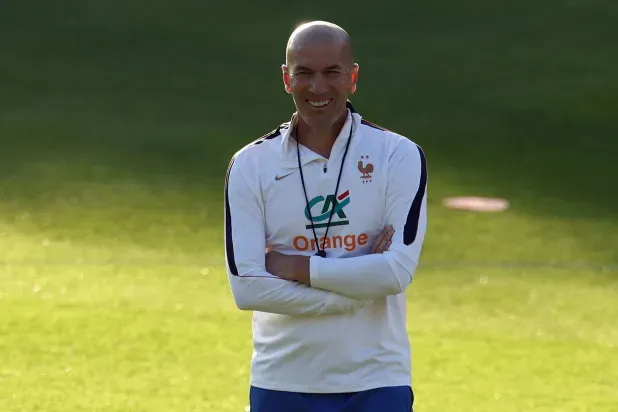
Zinedine Zidane’s first training session with the France national team on Monday at Clairefontaine was not a spectacle of fireworks, but a deliberate demonstration of control—a fitting introduction for a man whose greatest moments on the pitch were often defined by quiet dominance. Under the watchful eyes of around 50 journalists, Zidane guided a dozen players through a structured, low-intensity workout, his presence alone commanding respect. The session concluded with a short scrimmage and finishing drills, with Zidane himself delivering crosses to test the strikers’ first touch. Reports from the session described his trademark left-foot finesse as undiminished, a detail that carried weight given the passage of time since his playing days.
The absence of France’s biggest stars—Kylian Mbappé, Olivier Giroud, and others engaged in club commitments—did not diminish the significance of the moment. Zidane’s assistant, David Bettoni, a former Real Madrid colleague, and Fabien Barthez, his former teammate from the 1998 World Cup-winning squad, were present, reinforcing the continuity of a coaching staff built on shared history. The session’s structure—light on physical demands, heavy on technical refinement—suggested Zidane’s approach would prioritize positional play and fluidity, hallmarks of his playing style. His involvement in the finishing exercises was not just symbolic; it was a reminder that even at 52, his understanding of the game’s nuances remains razor-sharp.
France’s Nations League campaign begins in earnest next month, with Les Bleus facing Turkey and Belgium away before hosting Italy and Belgium at home. The schedule demands tactical adaptability, and Zidane’s first session hinted at a method that balances individual brilliance with collective discipline. The presence of young talents like Michael Olise, who trained alongside Zidane, signals an intent to blend experience with emerging talent—a strategy that could prove crucial in a competition where depth and versatility are paramount. The fact that Zidane chose to lead the session himself, rather than delegate, was telling: he is not merely returning to France as a manager, but as a figure who understands the psychological weight of the role.
What remains to be seen is whether Zidane’s leadership can replicate the magic of his playing era, when France dominated with a blend of technical mastery and fearless attacking. The Nations League will provide an early test, but the real measure of his success may lie in how he bridges the gap between the individual genius of his players and the collective identity of Les Bleus. For now, the first session has set a tone: one of patience, precision, and the quiet confidence of a man who has spent a lifetime proving that greatness is not about noise, but about making the right decisions at the right moment.