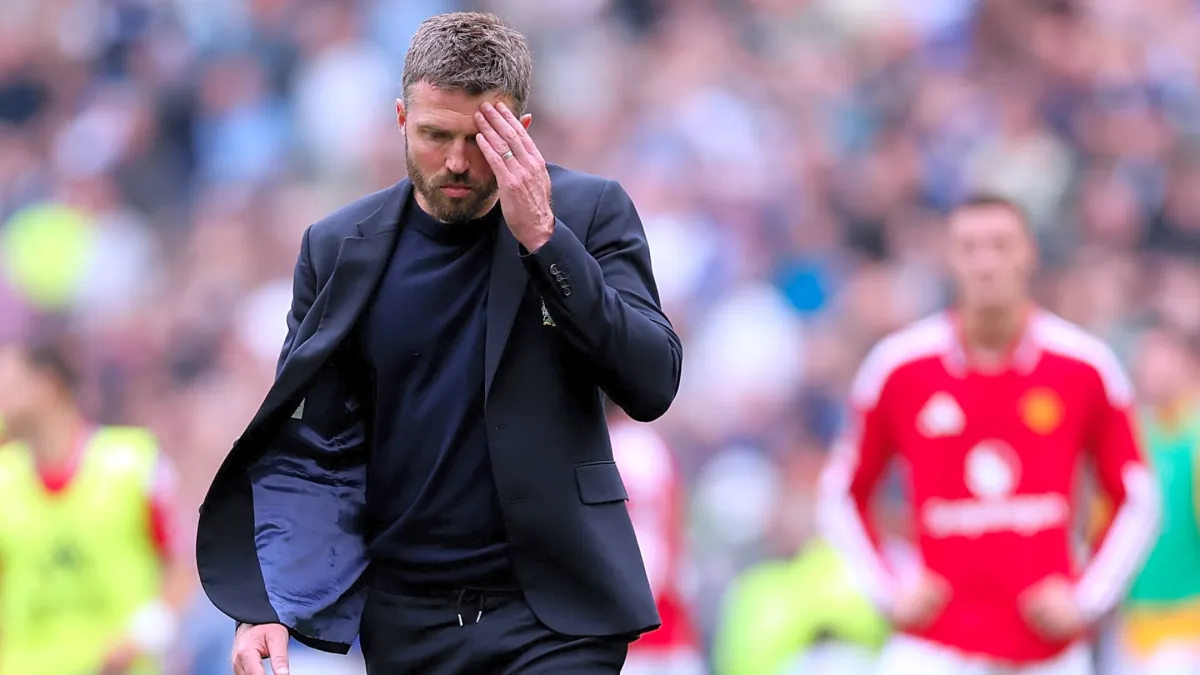
Manchester United’s season has unraveled with a velocity that even the most pessimistic fans could not have predicted. Three defeats in six games, a defense that has conceded more goals than any Premier League side in the opening month, and a midfield that has failed to provide the necessary stability—these are not isolated incidents but the cumulative result of a tactical and cultural breakdown. Yet, in the shadows of this collapse, Manchester United’s manager, Michael Carrick, has taken a calculated risk: a secret friendly against Lausanne-Sport, an INEOS-owned club, during the international break. The fixture, arranged without fanfare, is not merely a warm-up but a diagnostic tool, a chance to test new systems and reassess the squad’s foundations before the pressure of the next round of fixtures intensates.
The urgency of Carrick’s intervention cannot be overstated. The 2026-27 campaign has exposed deep-seated vulnerabilities that were either ignored or mismanaged under Ruben Amorim. The Portuguese manager’s indifference toward the club’s academy products—most notably Kobbie Mainoo, who was on the verge of a sale to Napoli—left a void that Carrick, a man with a deep-rooted connection to Manchester United’s youth system, has sought to fill. His presence in the dugout is not just about managerial experience; it’s about a tactical philosophy that prioritizes structure, positional play, and the development of homegrown talent. The secret friendly against Lausanne-Sport, a club that operates at a lower competitive level but shares the same ownership group, is a calculated gamble. It allows Carrick to experiment with formations, rotations, and defensive systems without the immediate scrutiny of a Premier League fixture. The stakes are high: if the squad fails to adapt, the consequences could be catastrophic.
The tactical implications of this move are as significant as they are subtle. Carrick’s approach has always been rooted in pragmatism, a willingness to strip back complexity when the system breaks down. The defensive collapse that has defined Manchester United’s opening months—with Senne Lammens yet to keep a clean sheet in the Premier League—suggests a fundamental issue with defensive organization, spatial awareness, or both. The friendly against Lausanne-Sport could serve as a controlled environment to address these flaws. If the defense remains porous, Carrick may need to introduce more defensive midfielders, adjust the backline’s shape, or even reconsider the role of key players. The absence of international players this weekend has further complicated matters, forcing Carrick to rely on loan signings and young talents like Mainoo, who has emerged as the club’s most promising academy graduate. His inclusion in this trial-by-fire scenario is not just a testament to Carrick’s faith in youth development but a necessary step to prevent further erosion of confidence.
The broader implications of this secret initiative extend beyond the immediate tactical adjustments. Carrick’s decision to arrange this friendly without media fanfare speaks volumes about the severity of the crisis at Manchester United. In an era where every training session and friendly is dissected for clues, the lack of transparency is deliberate—a recognition that the club’s problems are too deep to be solved with public spectacle. The move also signals a shift in power dynamics within the club. Carrick, who has spent years in the shadows of Manchester United’s managerial hierarchy, is now being given the space to implement his vision. Whether this strategy can reverse the club’s fortunes remains to be seen, but the fact that he has been entrusted with such a high-stakes experiment is a rare moment of optimism in an otherwise bleak season.
For now, the focus remains on the friendly itself. The results will not be the sole determinant of Manchester United’s fate, but they will provide critical insights into whether Carrick’s tactical adjustments can stabilize a squad that has lost its way. The clock is ticking, and the margin for error is vanishingly small. If the experiment fails, the consequences could be dire—not just in terms of on-field performance but in the long-term credibility of the managerial project. Yet, if it succeeds, even modestly, it could mark the beginning of a turnaround. One thing is certain: Michael Carrick’s secret friendly is not just a warm-up. It is a lifeline for a club drowning in its own mistakes.