

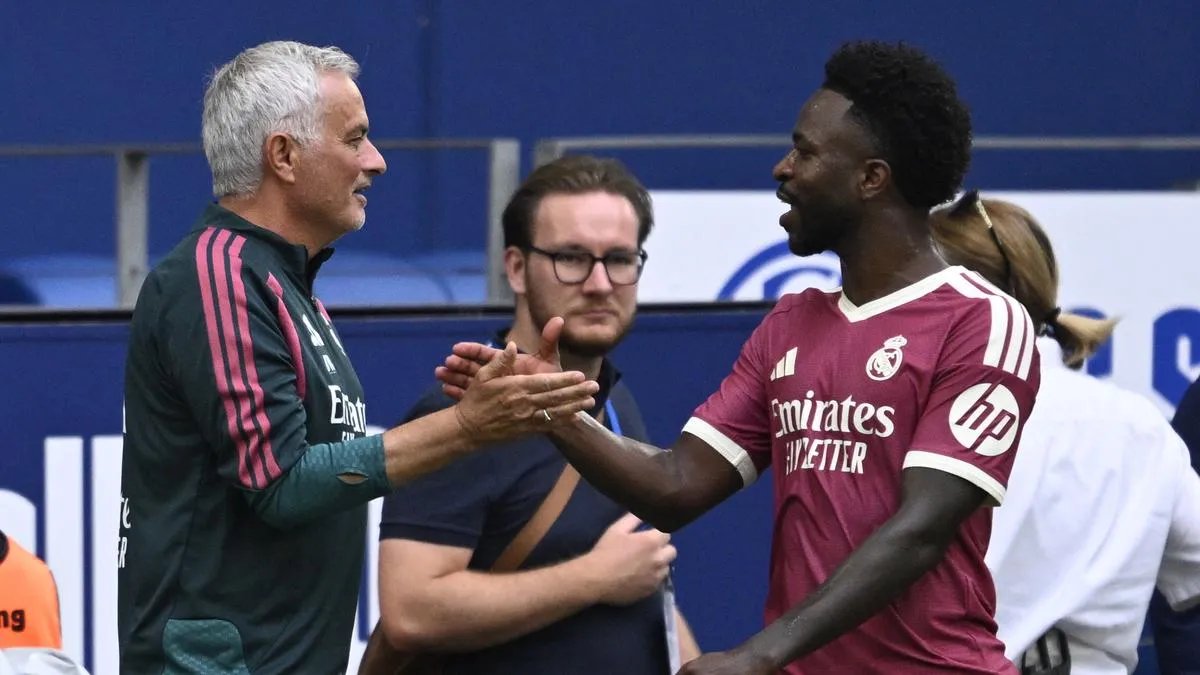
The unfiltered honesty of Jose Mourinho rarely disappoints, and his latest remarks about Vinicius Jr. have laid bare the psychological toll of playing at Real Madrid. In a candid moment ahead of Madrid’s upcoming clash with Sevilla, the Portuguese manager admitted that if he were in the Brazilian winger’s position—facing relentless abuse, red cards, and a four-match suspension for the Clasico against Barcelona—he would have sought an exit this summer. ‘If it were me in his place, probably I wouldn’t be here,’ Mourinho stated, underscoring the stark contrast between his own hypothetical response and Vinicius’s enduring loyalty to the club.
Vinicius’s resilience has long been a subject of fascination, particularly after his explosive debut at Real Madrid in 2018, where he became an instant target for racial abuse and physical intimidation. Yet, despite the hostility—including whistles at the Bernabéu and repeated red cards—he renewed his contract until 2032 in August, a decision that now appears to hinge on his belief that the situation will improve. Mourinho acknowledged this determination, calling Vinicius ‘a fantastic boy’ whose ‘joy for living and working’ remains unshaken. ‘He’s a Madrid fan, he has love for the club and the city,’ Mourinho explained, highlighting the emotional investment that keeps him rooted despite the external pressures.
The tactical implications of Vinicius’s absence from the Clasico add another layer to this narrative. With Madrid’s attack already navigating the complexities of balancing Vinicius, Kylian Mbappé, and Jude Bellingham—three of the world’s most sought-after forwards—his suspension raises questions about the team’s depth and adaptability. The winger’s role as a key figure in Madrid’s 2022 and 2024 Champions League triumphs underscores his importance, not just as a player but as a symbol of the club’s ambition. Yet, his current form and the mounting scrutiny suggest that Real Madrid’s future may require more than just tactical adjustments—it may demand a shift in the environment that has long defined his tenure.
Mourinho’s comments also serve as a rare glimpse into the internal dynamics of the club. While he praised Vinicius’s character, his own hypothetical departure reflects the broader frustration among players who feel undervalued or disrespected. The manager’s admission—delivered with his signature bluntness—hints at the unspoken tensions that persist beneath the surface of Madrid’s on-field dominance. For Vinicius, the challenge now is whether his faith in the club’s evolution will hold, or if the next step will be a move to a league where his talent can flourish without the constant weight of hostility.
One thing is clear: Vinicius Jr. has never been one to back down from adversity. Whether his story ends with a redemption at the Bernabéu or a bold transfer to a new chapter, his journey has already cemented his place in football history—not just as a player, but as a testament to the power of resilience in the face of systemic abuse.



