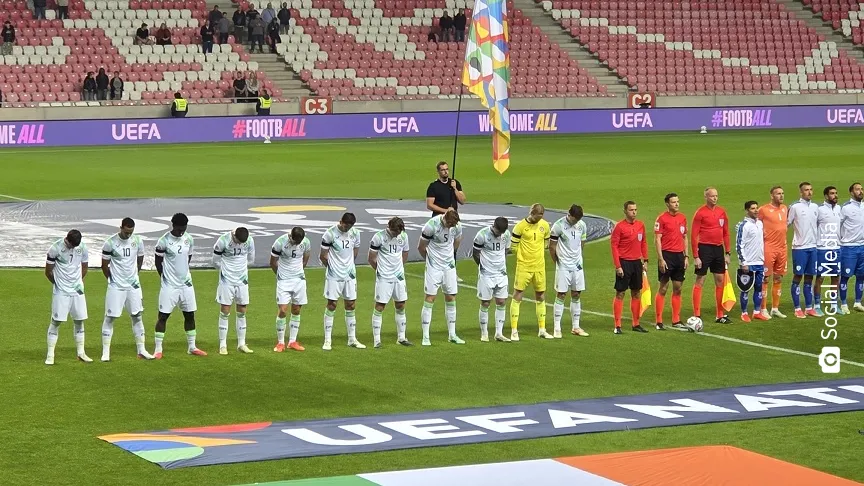
The Republic of Ireland’s approach to their UEFA Nations League match against Israel in Debrecen was anything but conventional. Before a single ball was kicked, the visitors made their stance unmistakable: no handshakes, no pennant exchange, and a collective bow during Israel’s national anthem. The team’s black armbands—worn in recognition of lives lost in Gaza—served as a visual declaration, while the absence of pre-match rituals sent a message that transcended the pitch.
The ceremony unfolded under heightened scrutiny. As the Irish squad marched onto the Nagyerdei Stadion, a small but vocal contingent of Israeli fans greeted them with boos and jeers—a reaction that mirrored the broader controversy surrounding the fixture. The FAI had preemptively framed the participation as neutral, with chief executive David Courell clarifying that Ireland’s involvement did not constitute endorsement of events in Gaza. Yet the actions on the field spoke louder than words. When Israel’s anthem played, the Irish players bowed their heads, a gesture of respect that was also a pointed refusal to engage in the ritual. The handshake snub—omitting even the customary exchange between captains Dara O’Shea and Manor Solomon—was the final, deliberate rebuke.
The tactical omission of the pennant exchange further underscored the team’s intent. In football, such rituals are symbolic acts of unity, but Ireland’s decision to bypass them entirely signaled a deliberate break from tradition. The moment was not lost on those watching. Former Tottenham striker Troy Parrott’s celebratory gesture after his early goal—mirroring a heart shape with his hands—was a rare moment of levity, though it did little to soften the match’s political undertones. The FAI’s earlier motion, calling for UEFA to suspend Israel from competitions, had already set the stage for this confrontation, and the players’ actions on Sunday confirmed that the debate would not be confined to the boardroom.
The match itself, a 3-0 victory for Ireland, was overshadowed by the pre-game drama. Jack Moylan’s emotional gesture—kissing his black armband after scoring the third goal—captured the moment’s duality: a personal tribute to the conflict’s victims, juxtaposed against the competitive edge of the game. The FAI’s stance had been clear from the outset, but the players’ collective decision to wear the armbands and refuse the handshake elevated the issue from policy to practice. It was a statement that would resonate far beyond the Hungarian stadium, forcing UEFA and the footballing world to confront the intersection of sport and geopolitics once again.
This was not the first time Ireland’s players had made such a stand. In 2024, the women’s basketball team had similarly refused to shake hands with Israel during a EuroBasket qualifier, though they later engaged in the ritual when the teams met again. The Nations League fixture, however, was different—a high-profile, neutral-venue clash that amplified the message. The FAI’s decision to participate in the first place, despite internal calls for a boycott, had already sparked debate. But the actions on Sunday made it undeniable: for Ireland’s players, the match was never just about football.