

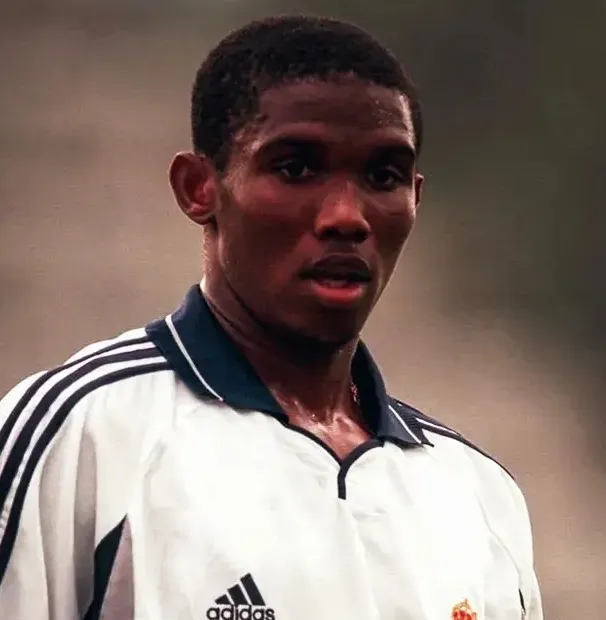
Samuel Eto’o’s arrival at Real Madrid in 1997 was supposed to be the beginning of a fairy tale. The 16-year-old Cameroonian prodigy, already a sensation in his homeland, had been signed by the Spanish giants with the promise of a future among Europe’s elite. But when he stepped off the plane at Barajas Airport, no one from the club was there to meet him. No coach, no scout, no representative—just an empty terminal and the weight of a young man’s dreams hanging in the balance.
The story, recounted by Eto’o himself in recent years, reveals a moment of stark contrast between the hype surrounding his arrival and the reality of his reception. With no one to guide him, he was left to navigate the unfamiliar territory alone, a far cry from the polished arrival of modern youth signings. This was not the Madrid of today, where scouts and support staff are meticulously prepared for every arrival. Instead, it was an era where raw talent often had to carve its own path, and Eto’o’s journey would prove no exception. His immediate placement in Castilla, Real Madrid’s B-team, was not a choice but a necessity—one that would later be criticized as a missed opportunity to nurture a player who would become one of Africa’s greatest.
Eto’o’s time in Madrid was brief but telling. The club’s decision to funnel him into the reserves, rather than integrating him into the first team, reflected both the challenges of managing young talent and the systemic underdevelopment of African players in European football at the time. It was a pattern that would repeat itself across the continent, where prodigies like him were often treated as commodities rather than future stars. Yet, Eto’o’s resilience would define him. His move to Mallorca for a then-club record £4.4 million became the catalyst for his transformation, where he flourished, scoring 70 goals in 165 games and winning the Copa del Rey—proving that even the most overlooked talents could rewrite their destinies.
The irony of Eto’o’s story is that the very moment of neglect at Barajas would later become a footnote in the annals of his legend. His eventual rise to become a Ballon d’Or nominee, a Champions League winner with Inter Milan, and the talisman of Cameroon’s golden generation made his early struggles seem almost quaint. Yet, the absence of support on that first day was not just a personal setback—it was a microcosm of the broader challenges African players faced in Europe. The system often failed them before they could even begin, forcing them to rely on sheer willpower to rise above the odds.
Today, Eto’o’s story serves as a reminder of how football’s greatest careers are built—not just on talent, but on the ability to thrive in adversity. His journey from an unmet arrival at Barajas to the heights of European and international glory is a narrative of perseverance that continues to inspire. It’s a tale that transcends the sport, offering lessons on resilience, adaptability, and the power of turning setbacks into comebacks. For a player who once had no one to greet him at an airport, his legacy is a testament to what can be achieved when determination outweighs circumstance.



