

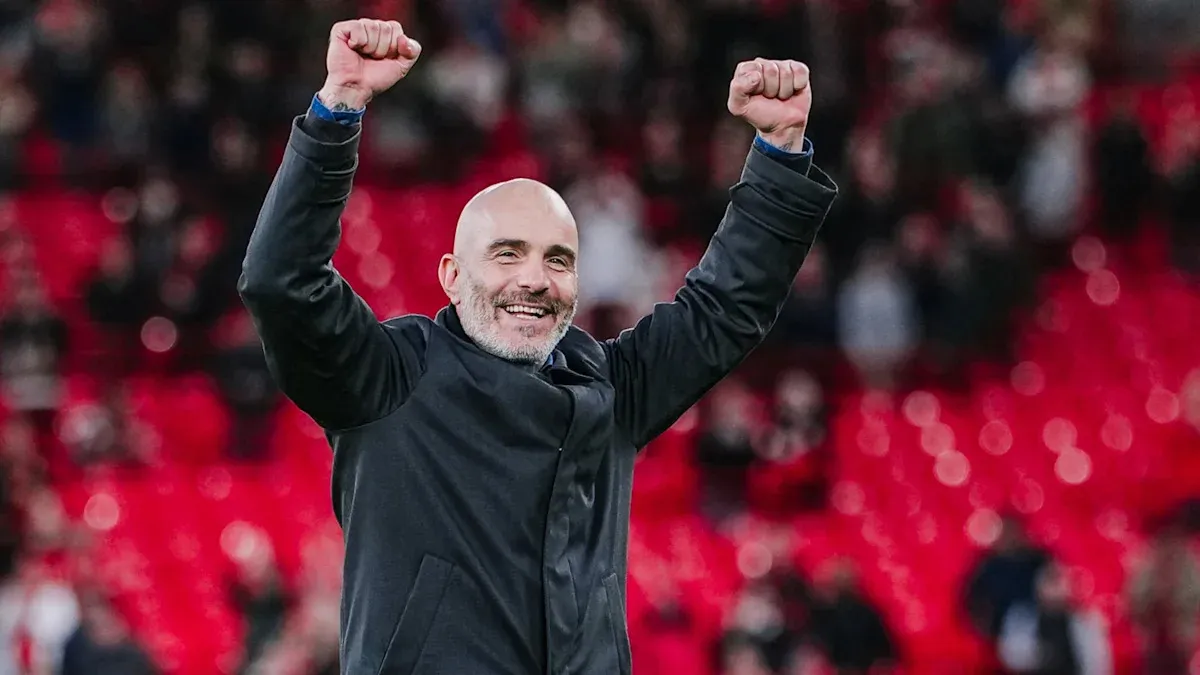
Enzo Maresca’s first Premier League victory as Manchester City manager wasn’t just a statement of intent—it was a collective exhalation. The 3-0 demolition of Liverpool at Anfield, secured with ruthless efficiency after a goalless first half, arrived at a pivotal moment for the club. With the independent commission’s verdict looming over the squad, the win wasn’t merely about three points; it was about proving that City’s identity—its unity, its hunger, its ability to thrive under pressure—remained intact.
Maresca’s post-match press conference carried the weight of the moment. ‘This kind of win is good for all the club,’ he declared, his tone measured but unmistakably triumphant. The words resonated beyond the scoreboard. For a club navigating financial scrutiny, internal transitions, and the specter of sanctions, the victory at Anfield served as a unifying force. The manager’s confidence in the organization—his repeated emphasis on ‘100% trust’ in the ownership, the CEO, and the sporting director—wasn’t performative. It was a declaration that, despite external chaos, the foundation remained solid. ‘I would like to talk about this situation when we win this appeal,’ he added, framing the legal battle as a distant concern, overshadowed by the immediate task: winning football matches.
The tactical execution was as decisive as the result. City’s late flurry of goals—Erling Haaland, Jeremy Doku, and Rayan Cherki—exploited Liverpool’s defensive frailties, particularly after the red card to Trent Alexander-Arnold. But the real edge came from the mental fortitude Maresca had instilled. His players, he noted, ‘don’t care too much about the noise’—a rare admission of indifference to the vitriol that often accompanies high-stakes football. The dressing room’s cohesion, reinforced by captains like Rodri and Kevin De Bruyne, was palpable. Even the absence of Pep Guardiola, who would later attend the next home game against Paris Saint-Germain, didn’t disrupt the rhythm. ‘After 10 years here, he can come at any time he wants,’ Maresca said, underscoring that City’s future wasn’t defined by nostalgia but by the present.
What made this win different was its timing. The club had spent months under a cloud of financial irregularities, with the threat of a points deduction hanging over them. Yet Maresca’s team treated Anfield as any other away fixture—no hesitation, no hesitation. The manager’s calm demeanor masked the stakes. ‘The environment is from the players,’ he said, acknowledging that the real challenge wasn’t the opposition but the internal resolve. The victory wasn’t just a rebound from a slow start; it was a reminder that City’s greatest strength lies in its ability to adapt, to regroup, and to deliver when it matters most.
For Liverpool, the defeat was a stark contrast to their recent form. The 10-man disadvantage didn’t just expose their defensive vulnerabilities; it laid bare the fragility of a side struggling to replicate their earlier-season dominance. But for City, it was a reset. The appeal against the financial penalties remains unresolved, but the message from Anfield was clear: this club’s culture of winning isn’t negotiable. Maresca’s first Premier League win as manager wasn’t just about three points—it was about reclaiming the narrative, one goal at a time.



