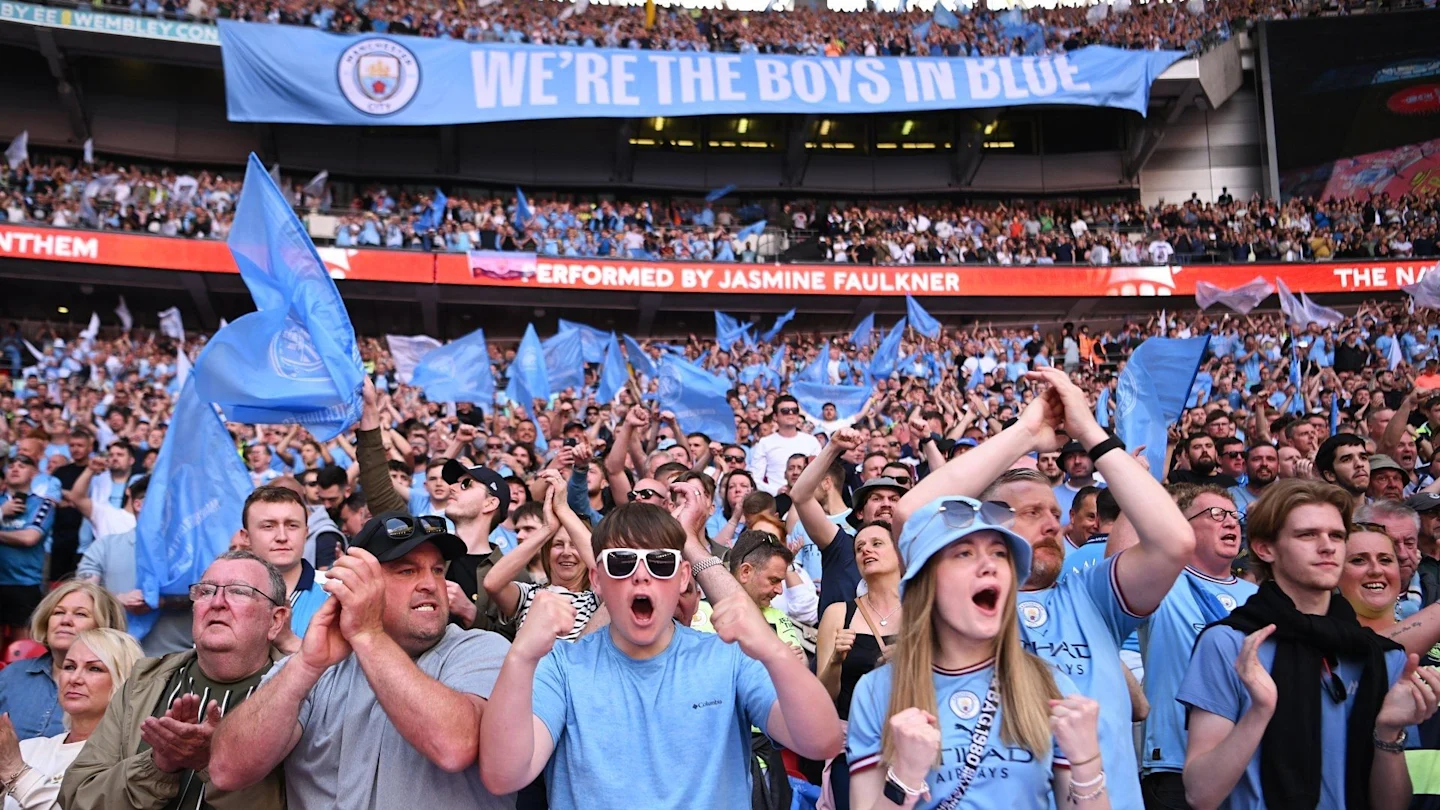
The football world has rarely witnessed a moment as fraught with consequence as the one now unfolding for Manchester City.
Sources confirm the Premier League and the EFL are in advanced discussions to impose a coordinated sanction regime against the club, a move that would mark the most aggressive collective response to perceived financial irregularities in modern football history.
The implications stretch beyond the pitch, threatening City’s very place in the game’s institutional order.
This is not merely a disciplinary matter—it is a test of whether the sport’s governing bodies can enforce accountability without destabilizing the sport’s economic foundations.
The scale of the potential punishment is still under negotiation, but the EFL’s willingness to collaborate with the Premier League signals a rare moment of unity between the two leagues.
Historically, such coordination has been absent, with each body operating in silos when it comes to financial governance.
Yet the gravity of City’s alleged breaches—reportedly involving both transfer spending and wage structures—has forced a reckoning.
The sanction could include points deductions, financial penalties, or even a temporary reduction in squad size, measures that would reverberate through the club’s domestic and European campaigns.
For a side that has dominated the Premier League for a decade, the prospect of such interference is nothing short of existential.
While the spotlight remains fixed on City’s predicament, the transfer market has already begun to react.
Dani Carvajal, now a free agent following his departure from Real Madrid, has emerged as a high-profile target for Premier League suitors.
Fulham, Liverpool, and Manchester City—yes, even the club under scrutiny—are all reportedly in contention for his signature.
Carvajal’s arrival would not only bolster a struggling side’s defensive depth but also serve as a tactical counterpoint to City’s current challenges.
His presence at any of these clubs would signal a shift in the league’s defensive landscape, particularly if Liverpool or Fulham opt to prioritize solidity over speculative attacking play.
The fallout from England’s 3–2 defeat to Spain at Wembley has further complicated the narrative around tactical integrity.
Anthony Gordon’s post-match interview, where he declared a preference for losing ‘attacking’ rather than ‘like a coward,’ laid bare the national team’s internal divisions.
His words, while passionate, underscore a broader debate about England’s identity: whether to embrace a high-risk, possession-based approach or adopt a more pragmatic, defensive structure.
The contrast with Spain’s disciplined, counter-attacking efficiency was stark, and Gordon’s remarks suggest the Three Lions are still searching for a cohesive identity—one that may not align with the current Premier League’s dominant style.
For Manchester City, the road ahead is fraught with uncertainty.
The potential sanctions could disrupt their title defense, while the transfer market’s reaction to Carvajal’s availability hints at a league-wide realignment.
Meanwhile, England’s tactical quandary mirrors the broader sport’s struggles to balance ambition with pragmatism.
The coming months will determine whether football’s governing bodies can enforce fairness without fracturing the game’s economic model—or whether Manchester City’s dominance will be rewritten by forces beyond their control.