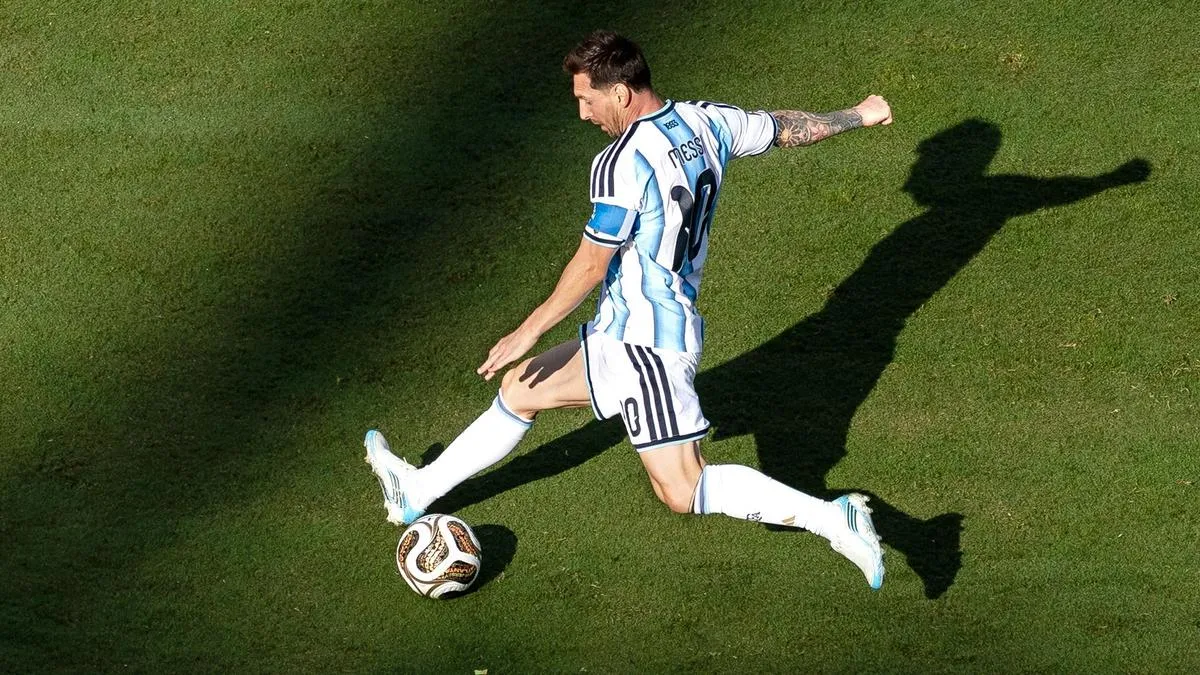
Lionel Messi’s farewell to Argentina is taking shape with the unveiling of a bespoke jersey, meticulously designed to honor his legacy while marking the end of an era. The 39-year-old, who has spent over two decades donning the sky-blue and white of *La Albiceleste*, will wear a custom-made kit for his final international match—a friendly against Benin on October 6 at Estadio Monumental in Buenos Aires. The jersey retains Argentina’s signature colors but introduces gold detailing around the collar, sleeves, and most prominently, the back, where ‘MESSI’ and his iconic No. 10 are emblazoned in gold. A Sun of May-inspired pattern, a nod to Argentina’s national symbol, surrounds the number, creating a visual narrative of his journey.
The design choices are deliberate, each element a tribute to Messi’s impact on the national team. The vertical white stripe replacing the traditional horizontal pattern may seem subtle, but it carries weight—symbolizing the singularity of his influence, a lone mark of distinction in a career defined by consistency. The gold accents, a color often associated with prestige and finality, elevate the jersey beyond a uniform, transforming it into a keepsake. Messi himself has framed the moment with simplicity: ‘One last match. A jersey for life,’ he wrote alongside the reveal, underscoring the emotional weight of the occasion. This isn’t just a farewell; it’s a ceremonial goodbye, a final bow to the fans who have witnessed his evolution from a prodigious teenager to the most decorated player in Argentina’s history.
Messi’s final appearance will be his 208th for Argentina, capping off a career that includes five major trophies: Olympic gold in 2008, two Copa América titles (2021 and 2024), the 2022 Finalissima, and the 2022 World Cup—a trophy he lifted just months before announcing his retirement. The Benin game was specifically scheduled as his send-off, a rare honor in a calendar often dominated by tournament commitments. His absence from the earlier friendlies against Bolivia and Burkina Faso ensured this match would be the sole chapter of his international story, a deliberate choice by manager Lionel Scaloni to create a moment of reflection and celebration. The Monumental, a stadium steeped in Argentine football history, will serve as the backdrop for this emotional climax, where Messi’s legacy—his goals, his leadership, and his resilience—will be etched into the fabric of the game.
The jersey itself is more than fabric and thread; it’s a visual manifesto of Messi’s career. The Sun of May, a symbol of Argentina’s founding, now encircles his No. 10, tying his personal narrative to the nation’s identity. The gold ‘MESSI’ on the back isn’t just a name—it’s a declaration, a final affirmation of his status as the face of Argentine football. Fans have already begun reacting, with some comparing the jersey to a priceless artifact, others reflecting on the tears and triumphs it has witnessed. For Messi, the match against Benin isn’t just a game; it’s a full stop to a sentence that began with a young boy in Rosario dreaming of glory. On October 6, he will step onto that pitch one last time, the jersey he wears a testament to a life spent chasing greatness—and finally, achieving it.
What remains unclear is how Messi will conclude his farewell. Will it be a quiet moment, a final whistle understated but profound? Or will it be a display of the same artistry that defined his career, a last flourish to leave fans in awe? Either way, the jersey he wears will be the last piece of the puzzle, a physical reminder of a chapter that has redefined football itself. For Argentina, this is more than a goodbye—it’s a farewell to an era, a transition from a generation defined by Messi to one yet to be written. The world will watch, not just for the final performance, but for the final image: a man in gold, standing tall under the Monumental lights, one last time as No. 10.