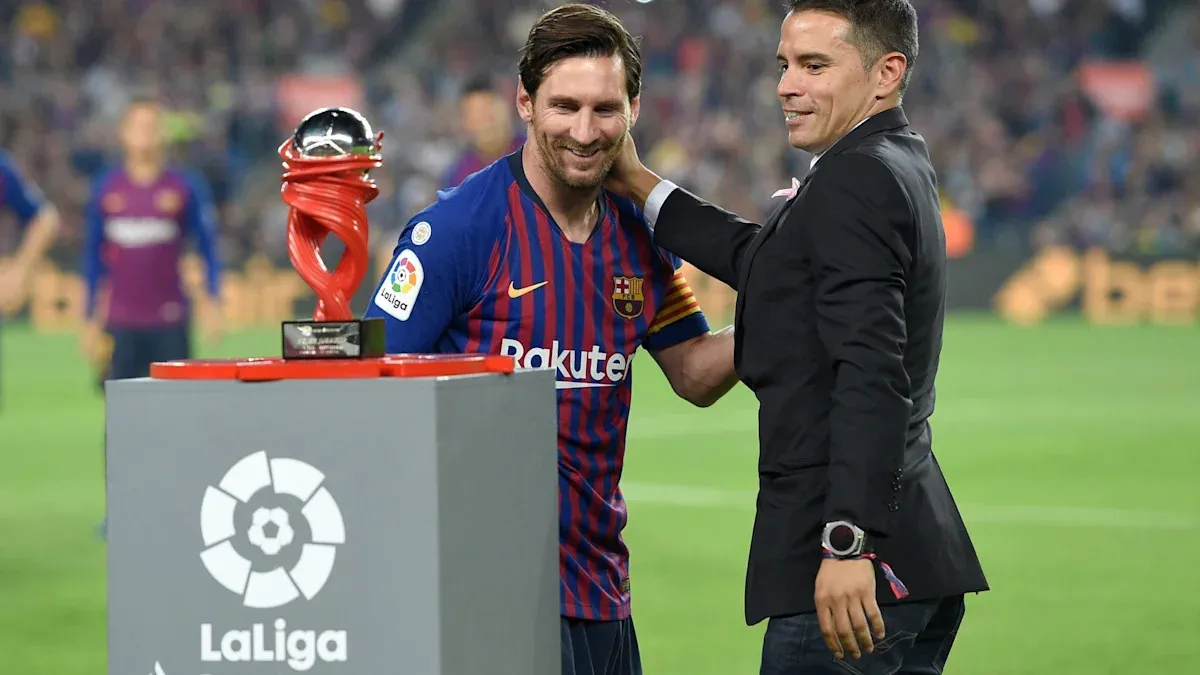
Javier Saviola has laid bare the moment he first understood Lionel Messi’s extraordinary talent, a revelation that underscores how rare a phenomenon the Argentine was even in his formative years at La Masia.
Speaking with uncharacteristic clarity, the former Barcelona and Argentina legend described Messi’s arrival as a child not just as promising, but as different—a player whose pace, dribbling and footballing intelligence set him apart from his peers.
“When I saw Messi at La Masia, I witnessed something I’d never seen before,” Saviola recalled. “The pace of his play, his dribbling, the determination with which he demanded the ball, and his incredible intelligence.”
These weren’t the traits of a typical youngster; they were the hallmarks of a player who would redefine the game.
Saviola’s words carry weight because he, too, was a product of La Masia, a system that has historically nurtured some of the most iconic talents in football history.
His caution over comparisons between Messi and Lamine Yamal isn’t merely academic—it’s rooted in the understanding that Barcelona’s academy is a crucible where raw potential is tempered by competition.
“Barcelona is a breeding ground for talent, but if someone manages to stand out amongst so many young players, it means they have something special,” he said.
Yet he refused to draw direct parallels, insisting that Yamal’s path must be measured on its own merits.
“Rexach was right: Messi was one of those talents born with an extraordinary gift,” Saviola acknowledged, but his emphasis was clear—Yamal’s legacy will be written in his own handwriting, not by the ink of Messi’s legend.
The contrast between the two players’ trajectories is telling. Messi’s arrival at La Masia was met with immediate recognition, even from those who didn’t yet grasp the full extent of his potential.
Saviola’s reaction—“We’re in the hands of a child. If he carries on like this, this guy will go a long way”—wasn’t just admiration; it was a forecast.
Yamal, meanwhile, has ascended with a rapidity that mirrors Messi’s early promise, but the pressure on him is different.
The expectations are higher not because of his individual brilliance, but because the comparison to Messi is inescapable.
Saviola’s warning is a reminder that greatness at La Masia isn’t just about dazzling ability; it’s about enduring under the microscope of Barcelona’s most demanding environment.
What Saviola’s reflections also reveal is the role of mentorship in uncovering talent. His own journey—from a young player in Argentina to a Barcelona star—was shaped by figures like Carles Rexach, who saw potential where others might have hesitated.
Rexach’s insistence that Saviola watch Messi wasn’t just a suggestion; it was a directive rooted in the belief that some players are born with gifts that defy categorization.
For Yamal, the challenge will be to prove that his talent isn’t just a product of his age or the system that shaped him, but a force that can stand alongside the greats who came before him.
Saviola’s words suggest that Barcelona’s next superstar will be judged not by how closely he resembles Messi, but by how uniquely he redefines the club’s legacy.
In the end, Saviola’s story is a testament to the power of La Masia—not as a factory for clones, but as a place where individuality is sharpened by competition.
Messi’s rise was extraordinary because he was extraordinary. Yamal’s will be extraordinary if he is extraordinary on his own terms.
The academy’s history is filled with players who were compared to Messi, but only a few have transcended the comparison.
Saviola’s caution is a call to focus on the present, not the past.
The question now is whether Yamal will answer that call—or whether the weight of expectation will become the very thing that defines him.