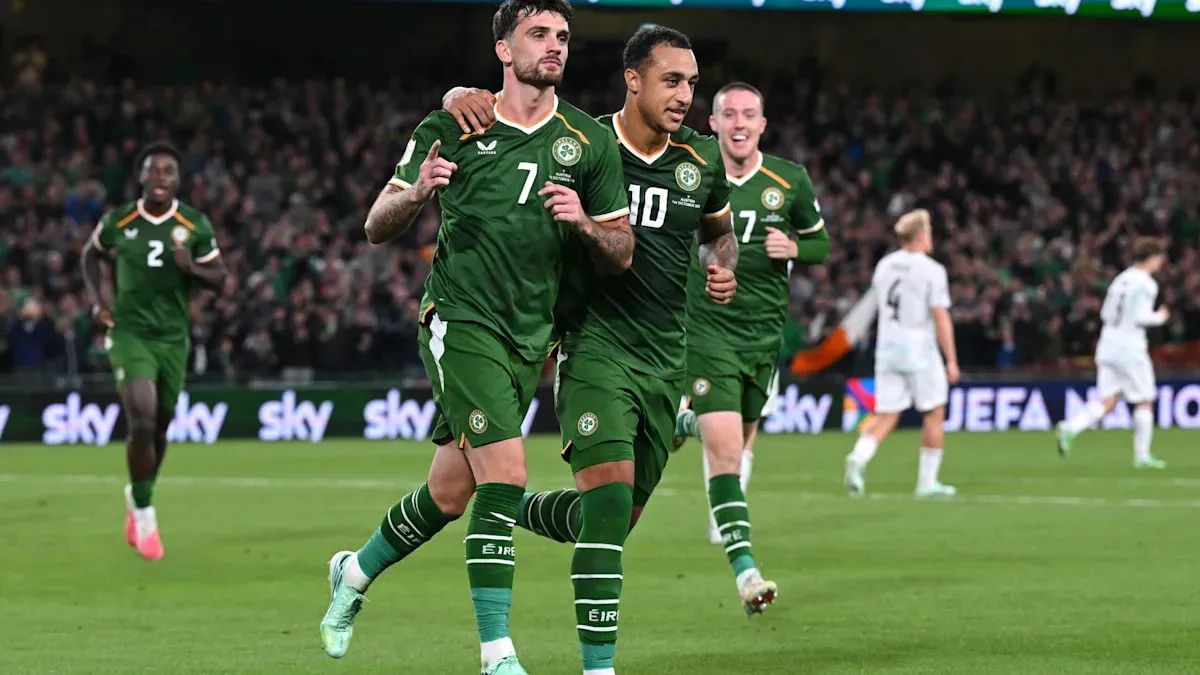
The Republic of Ireland’s UEFA Nations League campaign enters its decisive phase with a high-stakes clash against Israel at TSC Arena in Serbia on Sunday. The match, scheduled for 7:45pm BST, arrives after Ireland’s uneven start to Group B3—where a 3-0 demolition of Israel in Hungary contrasted sharply with their 1-0 defeat to Kosovo—has left Hallgrimsson’s side desperate to secure promotion to League A. The tactical battle lines are already drawn, with both teams set to deploy their signature 3-4-2-1 formations, though Israel’s adaptation to a groin injury for Daniel Peretz and Manor Solomon’s lingering back issue will test their depth.
Ireland’s predicted starting XI reflects Hallgrimsson’s cautious approach, with Liam Kitching returning to the back three despite limited recent starts, paired alongside James Egan and Conor O’Shea. The midfield trident of Jake O’Brien, Jayson Molumby, and Conor Coventry—backed by the defensive solidity of Josh Manning—will anchor the attack, where Troy Parrott and Adam Idah provide the creative and finishing threats. The absence of suspended defender James Abankwah and Dara O’Shea’s unconfirmed availability (due to his wife’s impending birth) forces Ireland to rely on younger players like Bosun Lawal, who could push for a start. Their recent form—including a dominant first-half performance against Israel—suggests they’ll look to replicate that early dominance, though Israel’s defensive structure, led by Eli Dasa and Liel Abada on the flanks, could disrupt their rhythm.
Israel’s probable XI, meanwhile, presents a tactical puzzle. With Omri Glazer stepping in for the injured Peretz between the posts, the side will pivot around the experience of Eli Peretz and Eran Azoulay in midfield, while Tai Baribo and Oscar Gloukh form a potent dual-target duo behind Manor Solomon. The absence of Anan Khalaily, who picked up an injury against Kosovo, weakens their defensive line, leaving them vulnerable to Ireland’s direct approach. Their formation—a rare 3-4-2-1 in recent matches—could expose gaps in their defensive organization, particularly if Ireland’s full-backs, such as O’Shea or O’Brien, exploit the space between the center-backs and wing-backs. The draw against Kosovo underscores their defensive fragility, a trait Ireland’s attack—led by Parrott’s movement and Moylan’s pressing—will target relentlessly.
The wider implications of this match extend beyond the immediate result. Ireland’s 3-0 win over Israel in Hungary demonstrated their ability to overwhelm opponents when their midfield dictates tempo and their forwards operate with purpose. Yet their draw against Austria—disrupted by protests—highlights the unpredictability of this Nations League campaign. Israel, for their part, have struggled to convert defensive solidity into results, a trend that could be their undoing against Ireland’s clinical finishing. The TSC Arena crowd, already energized by Ireland’s recent form, will demand a performance that cements their promotion hopes, while Israel’s players will be under pressure to prove their resilience in a system that demands both defensive discipline and attacking creativity.
With no room for error, both managers will prioritize tactical flexibility. Hallgrimsson’s bench, featuring players like Jack Moylan and Conor Knight, offers depth, while Israel’s reliance on younger players like Liel Abada and Eran Azoulay could be their Achilles’ heel. The midfield duel—where Ireland’s physicality meets Israel’s technical prowess—will be the match’s defining feature. One thing is certain: the team that controls the tempo and space will dictate the outcome, and the stakes could not be higher for either side.