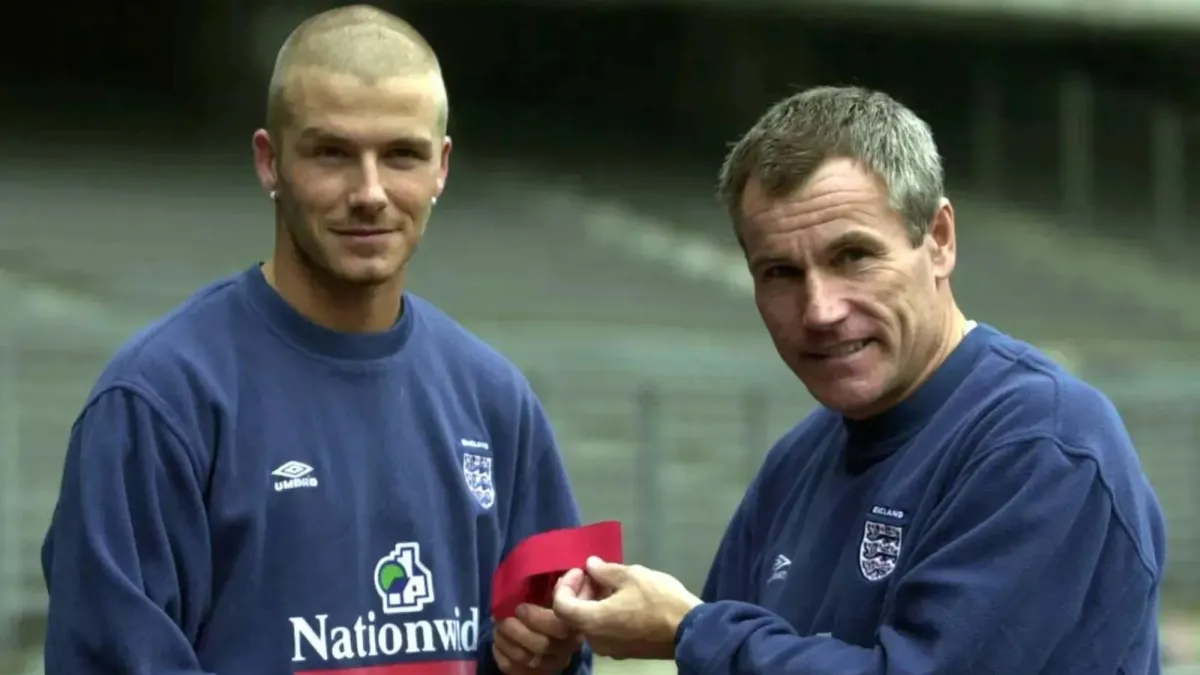
England’s captaincy has always been a role defined by controversy, but few transitions were as abrupt or as controversial as David Beckham’s rise to the armband in 2002. The path wasn’t paved by merit or consensus—it was forged in the crucible of a World Cup red card, a bitter defeat, and a public backlash so fierce it nearly ended his career. Yet four years later, against the same opponent in the same tournament, Beckham would not only reclaim his reputation but also secure a leadership position that outlasted the players who had once overshadowed him.
The catalyst was the 1998 World Cup, a tournament where Beckham’s name became synonymous with infamy. Sent off in the round of 16 against Argentina for a violent challenge on Diego Simeone, he was vilified by fans, pundits, and even his own teammates. Newspapers branded him ‘the stupid boy’ who had doomed England’s hopes, and the backlash was immediate. Yet the irony of history would see Beckham named England’s captain in 2002—before players like Steven Gerrard, John Terry, and Rio Ferdinand had even established themselves as vocal leaders. The reason wasn’t his tactical acumen or his on-field authority; it was the same incident that had once destroyed his reputation. That red card, far from ending his career, became the very reason he was trusted to lead.
The 1998 exit against Argentina was England’s most humiliating World Cup collapse in decades. Beckham’s dismissal left the Three Lions playing with 10 men for an hour, a tactical disadvantage that compounded their struggles. But the fallout extended beyond the pitch. Fans in Argentina hurled abuse at him, and the English media, desperate for scapegoats, amplified the outrage. Beckham admitted later that the incident shaped his career, forcing him to rebuild his image from scratch. Yet the same tournament that had broken him would later redeem him. In 2002, against the same Argentina side, Beckham took a penalty in the 44th minute of the round of 16—a moment of closure that silenced critics and restored his standing. The contrast between the two games was stark: in 1998, he was the villain; in 2002, he was the hero.
What followed was a quiet but deliberate shift in England’s leadership narrative. By the time Beckham was named captain in 2002, he had already proven his resilience—both on and off the field. His move to Real Madrid in 2003, where he became a global icon, further solidified his authority. The decision to appoint him ahead of younger stars like Gerrard or Terry wasn’t based on seniority alone; it was a recognition that Beckham’s ability to command respect—even after his 1998 misstep—made him the ideal figurehead. The Three Lions had always needed a leader who could bridge the gap between tradition and modernity, and Beckham, despite his controversial past, embodied that balance.
The legacy of that 1998 red card is a reminder that football’s greatest leaders are often forged in failure. Beckham’s journey—from pariah to captain—is a testament to how a single moment can define a career, not just in terms of talent, but in terms of character. Today, as England continues to search for its next generation of leaders, the story of Beckham’s redemption serves as a blueprint: leadership isn’t awarded for perfection, but for the ability to overcome the very mistakes that once threatened to destroy you.