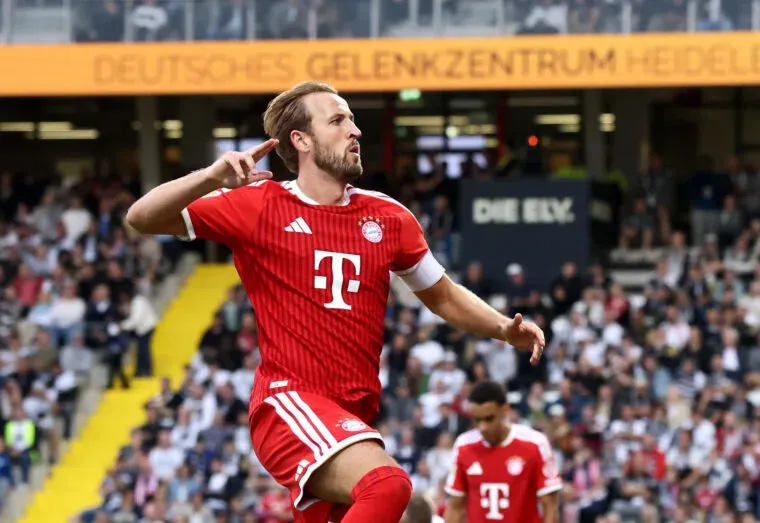
Harry Kane is the bookmakers’ favourite for the 2026 Ballon d’Or after scoring 73 goals for Bayern Munich and England in 2025–26, but the award remains far from decided. His extraordinary individual output, Bayern’s domestic success and England’s third-place World Cup finish give him a formidable case ahead of the ceremony in London on October 26.
Kane scored 61 goals for Bayern and 12 for England, including six at the 2026 World Cup. Bayern won the Bundesliga and DFB-Pokal, while Kane secured a third consecutive Bundesliga Golden Boot with 36 goals in 31 appearances. He also scored 14 Champions League goals, the highest single-season total by an English player in the competition.
His 73 goals came in 65 appearances, alongside eight assists. Kane’s combined output of 81 goal contributions represents the most prolific season of his career and puts him in rare historical territory, although claims that it is definitively the second-highest total ever by a player in Europe’s five major leagues should be treated cautiously because historical tallies differ according to whether unofficial matches, domestic super cups and international fixtures are included.
Kane is one of three England players on the 30-man shortlist, alongside Jude Bellingham and Declan Rice. His leading rivals include last year’s winner Ousmane Dembélé, Kylian Mbappé, Lamine Yamal, Erling Haaland, Lionel Messi, Achraf Hakimi, Vitinha and Khvicha Kvaratskhelia.
Paris Saint-Germain have a particularly strong presence in the voting, with Dembélé joined by Hakimi, Marquinhos, Nuno Mendes, Willian Pacho, Kvaratskhelia, João Neves, Fabián Ruiz and Vitinha; new signing Ferran Torres is also nominated. That collective representation may matter because individual award voting often rewards players whose seasons are tied to the largest club or international trophies.
Kane has acknowledged that winning the award would be a major personal honour but has sought to avoid overplaying his case. He said he does not like to boast, while adding that his “73 goals speak for themselves.”
The strongest argument against Kane is not his individual record but the weight voters place on the biggest trophies. Bayern’s Bundesliga and cup double is substantial, and England’s World Cup third place adds international credibility, but he did not win the Champions League or World Cup. Historically, those trophies often influence Ballon d’Or voting heavily.
Kane therefore enters the final stretch as the statistical front-runner, not the guaranteed winner. If voters prioritise sustained goalscoring, domestic silverware and a strong World Cup, he has an exceptional case. If they place greater emphasis on Champions League success, World Cup-winning performances or PSG’s collective achievements, Dembélé and other elite contenders could still deny England its first men’s Ballon d’Or winner since Michael Owen in 2001.