

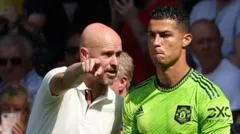
Erik ten Hag’s tenure at Manchester United was defined by contradictions: a tactical revolution stifled by a culture of individualism, a hunger for attacking football clashing with the ego-driven priorities of its star players. Among those contradictions, none was more explosive than his relationship with Cristiano Ronaldo. In a revealing assessment of their time together, the Dutch manager has made it clear: the nine-time Ballon d’Or winner did not just fail to meet his expectations—he let the team down.
Ten Hag’s frustration was never about Ronaldo’s ability. He acknowledged the striker’s legendary status, even admitting he respected him deeply. But respect, he insists, was not enough. The manager flew to Portugal before joining United to outline his vision for the club—a dynamic, possession-based system where every player, regardless of their individual brilliance, was expected to contribute to the collective. ‘We planned with him,’ Ten Hag said, ‘but he let the team down, and he let me down.’ The words carry the weight of a man who believed in a philosophy of accountability, where even the greatest players were accountable to the group. That accountability, it seems, was never fully reciprocated.
The breaking point came in the most humiliating of circumstances: Manchester United’s 4-0 defeat to Brentford in August 2022. After the match, Ten Hag imposed recovery runs—a punishment for a performance that had exposed the club’s vulnerabilities. Ronaldo, however, did not complete the full three laps. He finished only two. It was a small act, but one that symbolized a broader pattern: absences from training, a reluctance to elevate his heart rate to the required levels, and a refusal to align with the manager’s demands. Ten Hag’s frustration was not just tactical—it was cultural. ‘Players are powerful and they want to decide,’ he said, ‘but in my opinion, that didn’t suit the phase United was in.’ The message was clear: the club needed leadership that prioritized the team’s direction over individual whims.
The fallout was inevitable. Ten Hag’s decision to drop Ronaldo from the squad in late 2022 was not just a managerial move; it was a statement. The striker’s departure marked the end of an era at United, one where the club’s identity was increasingly defined by its stars rather than its system. For Ten Hag, the conflict was never personal. It was about the principles he believed in—a footballing philosophy where discipline, cohesion, and collective responsibility were non-negotiable. Ronaldo’s legacy at United remains untouchable, but Ten Hag’s assessment offers a rare glimpse into the friction between a manager’s vision and the realities of managing football’s most high-profile players.
Now, with both men’s careers on different trajectories—Ten Hag rebuilding at Bayern Munich and Ronaldo cementing his status as a global icon—their United saga serves as a cautionary tale. It underscores the delicate balance between individual greatness and team success, and the cost when that balance tips too far in one direction. For United fans, it also raises questions about the club’s future: Can it ever fully reconcile the demands of its stars with the needs of its system? Or will the search for that balance remain an unresolved tension at Old Trafford?



