

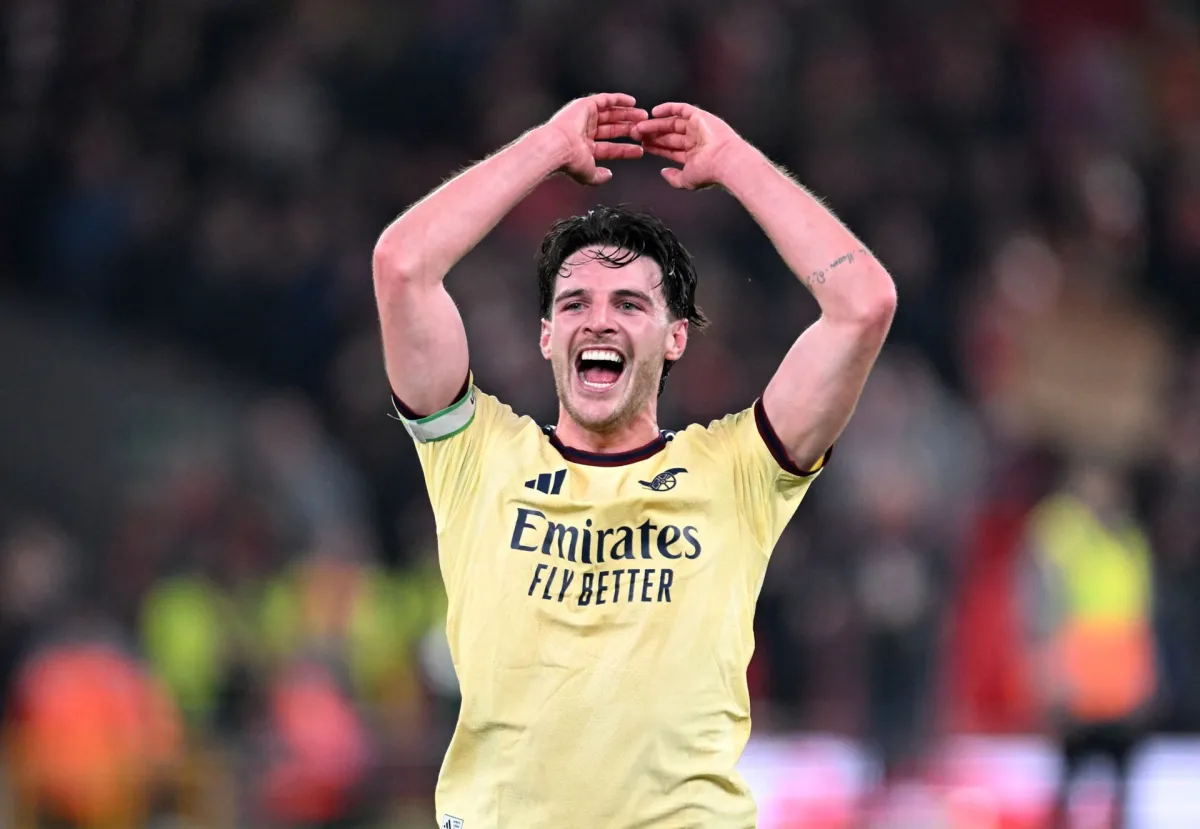
Declan Rice is the kind of player Mikel Arteta does not dare bench. At Anfield last season, his leadership and composure were the difference in a match where Arsenal’s midfield dictated the tempo. The 24-year-old’s ability to dictate play—whether through progressive carries, defensive solidity, or tactical intelligence—has cemented his role as the backbone of Arsenal’s system. Yet, his recent withdrawal from England duty has sparked conversation about his future, both at club and international level.
Henry Winter, a respected voice in football analysis, has gone further: Rice is Arsenal’s most important player. His influence extends beyond statistics. In a league where midfielders are often interchangeable, Rice’s presence stabilizes the entire team. His defensive work rate, ball-winning ability, and ability to transition seamlessly from deep-lying playmaker to direct runner make him indispensable. Arteta’s reluctance to substitute him underscores his trust—not just in Rice’s skill, but in his leadership. When Arsenal’s midfield falters, it is often because Rice is not there to dictate the rhythm.
The debate over England’s captaincy adds another layer to Rice’s narrative. While Jude Bellingham’s rise is undeniable, Rice’s experience, physicality, and tactical awareness make him a more natural leader. Winter’s suggestion that the captaincy should shift from Martin Ødegaard to Rice reflects a broader recognition of Rice’s maturity. Ødegaard’s creativity is invaluable, but Rice’s ability to command respect in high-pressure moments—whether in the Premier League or Champions League—positions him as the more suitable figurehead. His recent absence from international duty, however, has drawn criticism, raising questions about his commitment to England’s long-term ambitions.
Rice’s potential disappointment over missing the Ballon d’Or could also serve as a catalyst for another level. The award’s snub to a player of his caliber is a rare moment of public scrutiny, but it may also sharpen his focus. His next season at Arsenal—where he will face even greater challenges in a competitive league—could be the proving ground for a new phase. Whether he steps into a more prominent leadership role at club or country level, Rice’s trajectory remains one of the most compelling stories in modern football.
For now, the question is not whether Rice will continue to dominate, but how his next chapter unfolds. His influence on Arsenal’s midfield is unmatched, and his potential as a captain—both on and off the pitch—cannot be ignored. The debate over his future is less about whether he belongs at the forefront, and more about how he will shape it.



