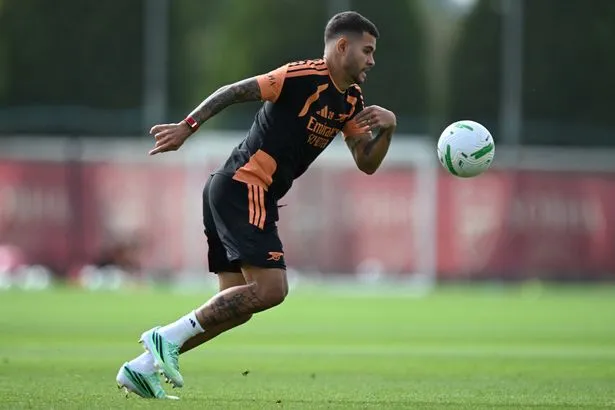
Bruno Guimarães’ departure from Newcastle United was never just a transfer. It was a declaration. After five years at St James’ Park – a tenure defined by leadership, consistency, and the weight of expectation – the Brazilian midfielder’s decision to force his way out of Tyneside in the summer was framed not by ambition alone, but by a quiet, internal reckoning. In a rare moment of candour, Guimarães admitted he had “felt inside” that he needed a new challenge, a shift that came after months of private deliberation with his advisors and a club that, until the final moments, fought to keep him.
The words came during an international break, a rare pause in the whirlwind of his transition. “I had already been at the club for almost five years,” he reflected, his tone measured but unmistakably final. “I felt inside that I needed a new challenge, I was ready for it.” The phrasing was deliberate: not a whim, not a fleeting desire, but a conviction born of time. Newcastle had been his home since 2022, the club where he became a captain, a talisman, and the face of a side that flirted with European football. Yet even as he spoke of gratitude – “I am very grateful to the club for everything it has given me” – the weight of his decision was clear. The move to Arsenal, secured after a summer of tense negotiations for a fee around £75 million, was not just about money or trophies. It was about the next chapter of his career, one he was determined to write on his own terms.
The emotional toll of leaving was evident in his words. Guimarães acknowledged the “new responsibility” he now carries at Arsenal, a shift that requires “a little time, a little adaptation.” His first months in north London have been marked by the pressure of living up to the price tag, but his debut goal against Sunderland – a strike that silenced the home crowd and marked his arrival – was a statement in itself. “I had an amazing history at Newcastle,” he said after the match, his voice steady. “Now I’m trying to create a new history here.” The goal wasn’t just a personal triumph; it was a declaration that his journey at Arsenal had begun in earnest. Yet beneath the celebration, there was no bitterness. Only forward momentum.
Newcastle’s reaction to his departure has been a mix of frustration and reluctant respect. Manager Eddie Howe, who had publicly urged Guimarães to stay, admitted the player’s character had never been in question. “He’s just a great player and a great person,” Howe said, though the words carried the weight of a man who had lost a leader. The club’s fanbase, meanwhile, has grappled with the fallout, debating whether Guimarães’ move mirrors Alexander Isak’s defiant exit the previous summer. But unlike Isak, who held out for a £125 million windfall, Guimarães has shown no signs of causing disruption. His return to training and pre-season preparations – without drama, without ultimatums – suggests a player who, despite the emotional cost, is focused on the road ahead.
What remains unclear is whether Newcastle will ever fully recover from the loss of their captain. Guimarães was more than a player; he was the emotional anchor of a side that had spent years chasing stability. His departure leaves a void, one that will be harder to fill than any transfer fee could compensate. For Arsenal, though, the acquisition represents a calculated gamble. Guimarães’ ability to dictate tempo, his experience, and his leadership are assets in a midfield that has struggled for cohesion. Whether he can replicate his Newcastle magic in north London remains to be seen. But one thing is certain: his story is far from over. The new history he’s determined to write has only just begun.