

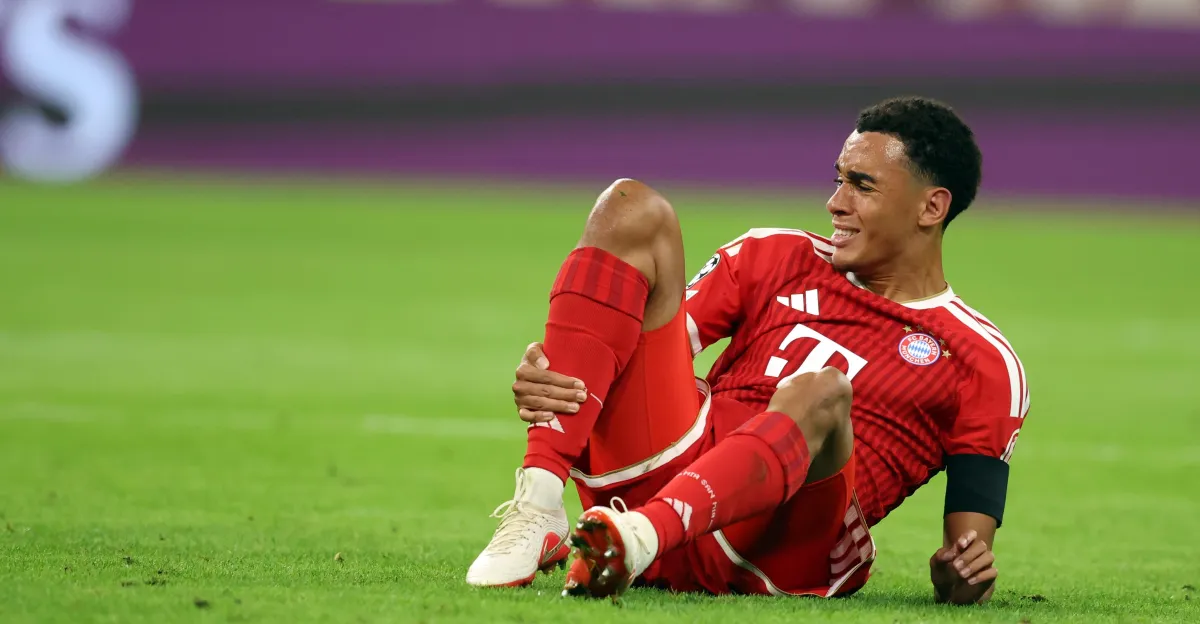
Bayern Munich’s medical department has made its position crystal clear: Jamal Musiala’s recovery is not a race. The attacking midfielder, whose career trajectory was already disrupted by a catastrophic injury at the 2025 Club World Cup, now faces another prolonged setback. His foot was trapped beneath Gianluigi Donnarumma’s weight in a collision that left him with a plate removed—a physical reminder of the severity of his initial trauma. Since then, a cascade of muscular injuries, recurring fatigue, and inconsistent form has kept him sidelined, with no return date confirmed beyond late October at the earliest.
The timing of Musiala’s potential comeback is deliberately tied to two high-stakes Bundesliga fixtures: the clash against Magdeburg and the showdown with Borussia Dortmund. Both matches carry weight beyond their immediate results—Magdeburg’s promotion-relegation battle and Dortmund’s title race make them pivotal for Bayern’s domestic stability. Yet the club’s reluctance to rush him back reflects a deeper tactical calculus. Musiala’s absence has already forced Vincent Kompany to adapt midfield rotations, with Vincent Kompany himself acknowledging the need to prepare for scenarios where both he and Manuel Neuer might be unavailable against RB Leipzig. The priority remains avoiding short-term fixes that could exacerbate long-term damage.
Musiala’s road to recovery has been fraught with setbacks, even after what was initially perceived as a breakthrough. His first full 90 minutes since the Club World Cup injury came in Bayern’s 7-0 demolition of Union Berlin, a performance that briefly reignited optimism. Yet that momentum was swiftly undermined by a multi-week injury sustained during Germany’s international break, further delaying his return. The club’s patience is not merely medical caution—it’s a reflection of the high stakes attached to his fitness. A premature return could risk another collapse, as seen in his seizures during training earlier in the season, which Kompany dismissed as ‘no big deal’ but which underscored the fragility of his current state.
For Musiala, the psychological toll of this prolonged absence cannot be overstated. His exclusion from Jürgen Klopp’s Germany squad during the international break was a symbolic blow, reinforcing the isolation of his injury cycle. The 23-year-old’s ability to regain his rhythm will hinge on more than physical rehabilitation—it will demand mental resilience and tactical reinvention. Bayern’s midfield, already rebalanced without Thiago and Joshua Kimmich, must absorb his absence without fracturing. If Musiala returns in late October, his role will be scrutinized as never before: Can he reclaim his creative dominance, or will his injury history cast a shadow over his form?
The broader implications stretch beyond individual performance. Bayern’s 2026/27 season is already defined by uncertainty—Neuer’s availability, the departure of key players, and the pressure to maintain dominance in a league where no team is invincible. Musiala’s return, or lack thereof, will be a litmus test for the club’s ability to navigate adversity. For now, the message is clear: Patience is the only viable strategy. The question is whether the timing will align with Bayern’s ambitions—or if Musiala’s story will become another chapter in the club’s resilience narrative.



