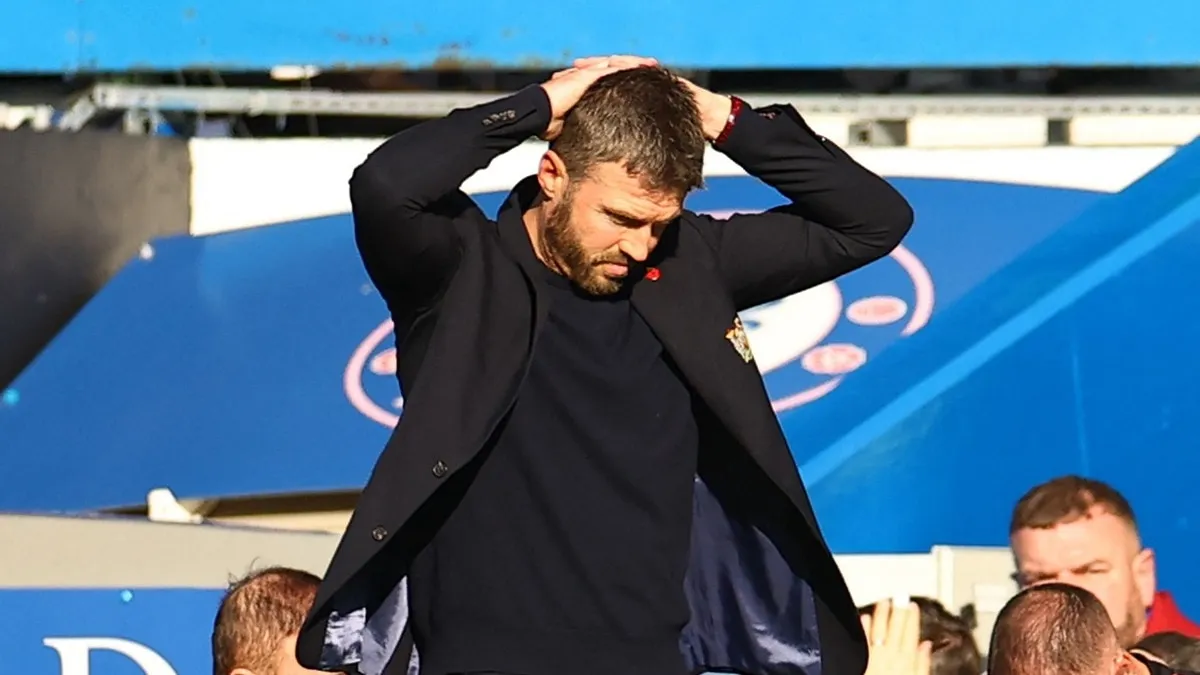
Manchester United’s latest defeat at Chelsea has not only extended their winless run to nine matches across all competitions—their longest since September 1984—but has also confirmed what many already feared: Michael Carrick’s time in charge may be running out. Yet, despite the mounting evidence of a team in freefall, the club has chosen to give him one more opportunity. That decision, announced after a 2-0 humiliation at Stamford Bridge, signals a rare moment of defiance in a season where every result has been a step backward.
The scale of the problem is stark. In eight games without a win, United have conceded 15 goals while scoring just six, a defensive collapse that has exposed the fragility of their defensive structure. Opponents have exploited the gaps between midfield and attack with ruthless efficiency, while the team’s tactical identity—once a hallmark of Carrick’s interim spell last season—has dissolved under the weight of inconsistency. Players like Lisandro Martínez and Bruno Fernandes have publicly questioned the direction of the project, with Martínez calling for higher standards and Fernandes voicing frustration over tactical execution after a 4-1 Champions League defeat to Como. The message from the dressing room is clear: the club’s ambition has been lost in the chaos.
Carrick’s leadership has been tested like never before. His interim tenure last season was marked by a disciplined, if unspectacular, approach that at least stabilised the ship. This time around, however, the Red Devils have struggled to replicate that structure. The defensive frailties—whether through positioning errors or a lack of defensive cohesion—have been a recurring theme, while the attack, once a source of hope under Carrick’s guidance, has become a liability. The upcoming fixtures only add to the urgency: an away trip to Chelsea in the Premier League followed by a Champions League clash against Roma will test whether Carrick can turn things around in the space of a week.
The decision to keep him in place is not without precedent. Manchester United has a history of clinging to managers in the face of adversity, often with disastrous consequences. Yet this time, the stakes are higher than ever. The club’s financial situation, the pressure from fans, and the looming threat of relegation all combine to create a perfect storm. Carrick’s ability to navigate this crisis will be measured not just by results, but by whether he can restore belief in a squad that has lost its way. For now, the answer remains uncertain—but the clock is ticking.