

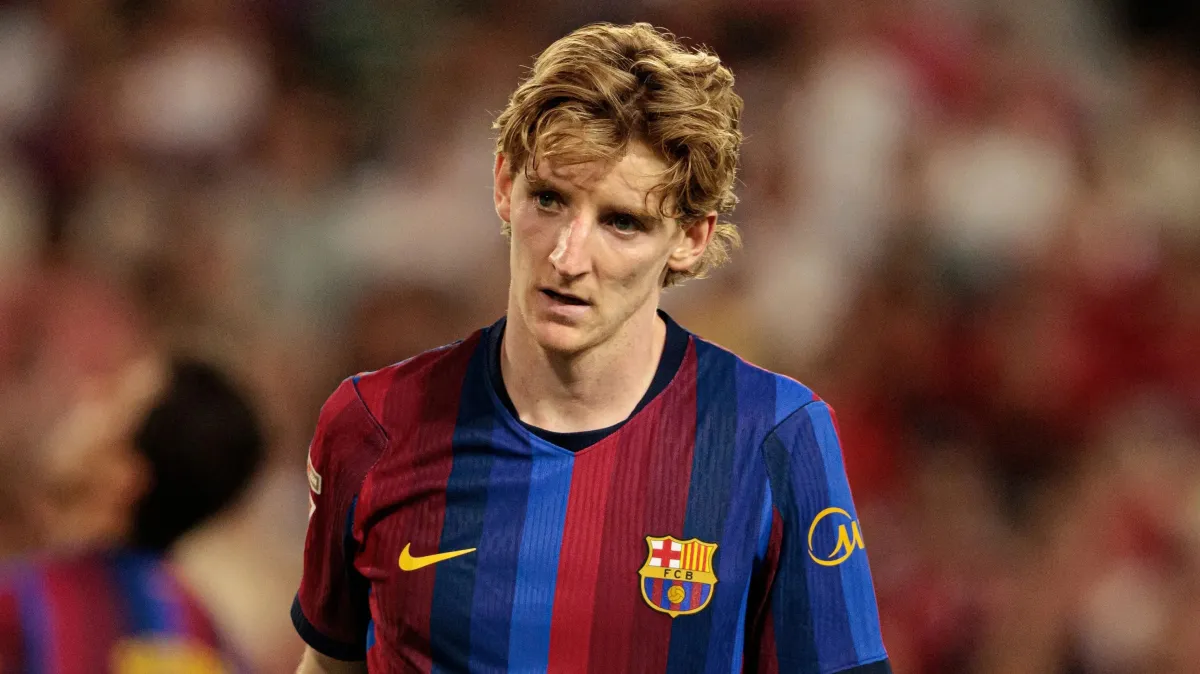
Anthony Gordon’s recent comments about Pedri’s influence at Barcelona have inadvertently reignited friction with his former Newcastle United teammates, offering a rare glimpse into the shifting dynamics of a club now led by a midfield revolution. The England international, who completed his £70 million transfer to the Catalan giants this summer, has emerged as one of his nation’s most consistent performers during the recent international break. His goals against Spain, the Czech Republic, and a dominant 7-0 demolition of Croatia underscore his continued sharpness, yet his praise for Pedri’s playmaking—delivered in the same breath—has not gone unnoticed in Newcastle’s dressing room.
Pedri’s arrival at Barcelona marked the beginning of a deliberate overhaul of the club’s midfield, a position that has long been a focal point of its tactical identity. The 22-year-old’s ability to dictate tempo, unravel defenses, and elevate the quality of passing in front of him has been a defining feature of his time in La Liga. Gordon’s observation—made without apparent malice—serves as an unintended reminder of how far Barcelona has progressed under Xavi Hernández’s leadership. The contrast between the club’s current project and the one he left behind is now impossible to ignore, particularly for players who may feel overshadowed by the rapid evolution of their former side.
Newcastle United’s midfield, once a creative hub under former manager Eddie Howe, now operates under the shadow of Barcelona’s ambition. The club’s tactical approach has been criticized for its reliance on direct play and a lack of positional intelligence, a stark deviation from the fluid, possession-based football that defines the Catalan model. Gordon’s words, while framed as admiration, carry an undercurrent of irony for those who remember Newcastle’s midfield as a place where creativity thrived—until the departures of players like Jonny Howson and Bruno Guimarães left a void. His praise for Pedri’s adaptability and vision now feels like a subtle dig at the direction his own club has taken, where tactical cohesion has become a recurring point of contention.
The timing of Gordon’s comments is particularly notable, arriving as Barcelona prepares to face a new set of challenges in the upcoming season. The club’s midfield trio of Pedri, Gavi, and Frenkie de Jong is widely regarded as one of the most formidable in world football, a unit that blends youthful exuberance with tactical precision. For Gordon, who has spent his career navigating the pressures of high-level football, the contrast between his new environment and the one he left is undeniable. His ability to thrive in Barcelona’s system—where defensive discipline and positional play are paramount—will be a key indicator of his long-term success. Meanwhile, Newcastle’s midfield must grapple with the reality that the club’s future may no longer be built on the same principles that once defined its identity.
What remains clear is that Gordon’s words, whether intentional or not, have added fuel to a conversation that was already simmering. The divide between the two clubs’ tactical philosophies is now more pronounced than ever, and his comments serve as a microcosm of the broader narrative: Barcelona is moving forward with purpose, while Newcastle is left questioning how to recapture the magic of its past. For Gordon, the challenge ahead is not just to replicate his international form at club level, but to integrate seamlessly into a project that is redefining the very nature of modern football.



