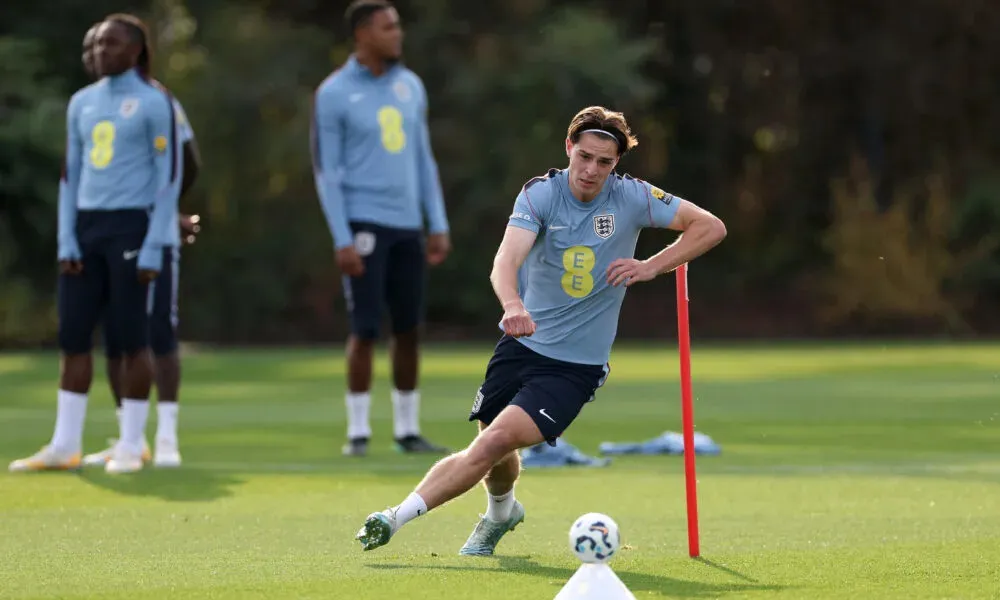
Alex Scott’s competitive debut for England was a fleeting but telling moment—one that has since forced him to confront the reality of his midfield battle. The AFC Bournemouth midfielder came on for the Three Lions in the second half of Tuesday’s UEFA Nations League victory over Czechia, replacing Elliot Anderson in a 2-0 win that saw Anthony Gordon and Harry Kane seal the result. While his presence on the pitch was a welcome addition to Gareth Southgate’s squad, Scott’s admission afterward underscores the pressure he now faces: the need to elevate his game to a level where he can consistently challenge for a starting spot.
The Nations League appearance was Scott’s first for England, but it was not without significance. Entering the match as a substitute, he was thrust into a midfield that had already delivered two goals, and his defensive work rate and positional awareness were immediately scrutinized. The victory itself was a statement of intent for England, but for Scott, it was a reminder that his path to regular selection is not guaranteed. His admission—made in the days following the match—reflects the harsh truth of modern midfield competition: even a promising debut does not erase the need for sustained improvement. The Three Lions’ squad is deep, and Southgate’s tactical flexibility means that players must prove their worth in every training session and friendly.
Off the pitch, Scott’s personal life has added another layer of complexity to his professional journey. His late grandfather, a lifelong fan, passed away just days before the Nations League match, a loss that has left him grappling with grief while also navigating the demands of international football. The emotional weight of such a timing cannot be understated, yet it has not deterred Scott from focusing on his development. His determination to honor his grandfather’s memory—who was, as he described, his ‘biggest fan’—now intersects with his ambition to carve out a permanent role in England’s midfield. The challenge is clear: he must translate his potential into consistency, a task that will require not just tactical refinement but also mental resilience.
The broader implications of Scott’s situation extend beyond his individual journey. England’s midfield is a battleground, with players like Jordan Henderson, Declan Rice, and Kalvin Phillips vying for positions alongside emerging talents like Scott and Anderson. The Nations League provided a snapshot of Southgate’s rotation strategy, but the real test will come in qualifying matches and beyond. For Scott, the road ahead is one of proving that his technical ability and physical attributes can meet the demands of a modern midfielder—one who must excel in both defensive organization and creative play. His admission is not a sign of defeat but a recognition that the battle for England’s heart of the midfield is far from over.
What remains to be seen is whether Scott can channel this self-awareness into tangible progress. The Nations League was a step forward, but the next chapter will be written in the coming months, where his performances in training and competitive matches will determine whether he becomes a regular in Southgate’s plans. For now, the midfield battle rages on, and Scott’s willingness to confront his shortcomings head-on may be the difference between fleeting opportunities and a lasting legacy.