

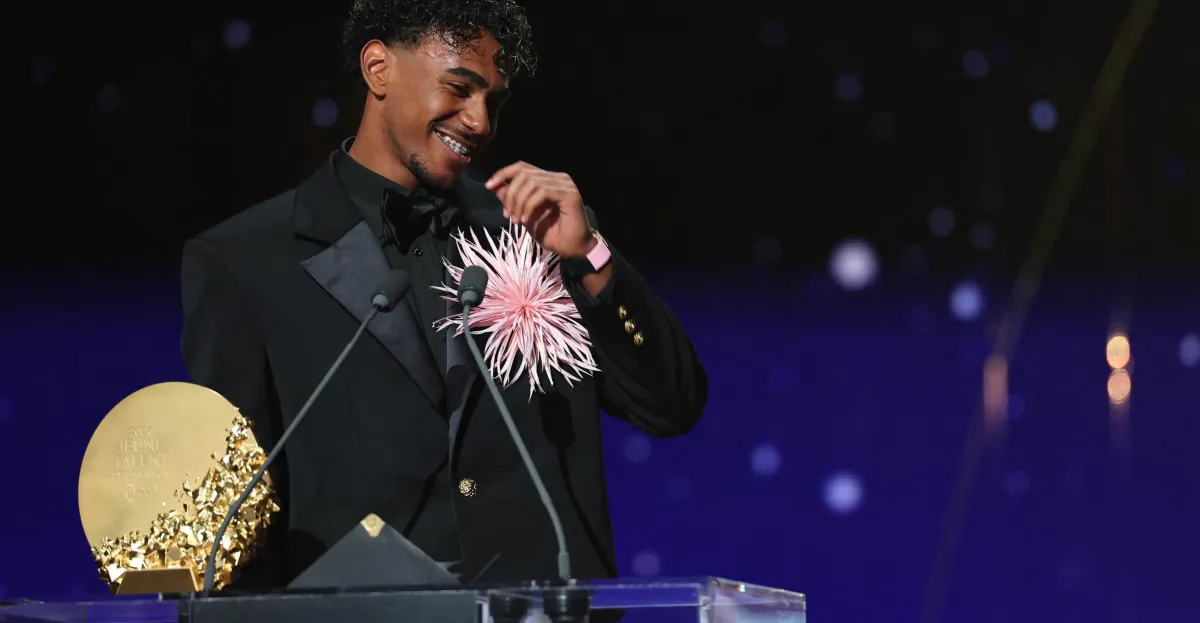
Lamine Yamal’s third consecutive Kopa Trophy victory at the Ballon d’Or gala in London was a moment of unparalleled achievement—yet the Spanish winger’s acceptance speech was not about celebrating his own record. Instead, he directed the spotlight toward his Barcelona teammate Pau Cubarsi, declaring that the 19-year-old defender deserved the honor more than he did. ‘I would have liked to see my team-mate Cubarsi here,’ Yamal said. ‘I think this prize should have been for him. He deserved it.’ The words were a rare public acknowledgment of another player’s superiority, underscoring how deeply Yamal’s career has intertwined with Cubarsi’s rise at the heart of Barcelona’s defense.
Cubarsi’s case was compelling. The young center-back, who made 48 appearances for Barcelona last season, became a linchpin in both club and country. His performances were instrumental in Spain’s 2026 World Cup triumph, where he was named Young Player of the Tournament—a distinction that mirrored the Kopa Trophy’s criteria. Yet while Yamal’s dazzling play—16 goals and 11 assists in La Liga, plus six goals in the Champions League—earned him the league’s Player of the Season award, Cubarsi’s defensive mastery and leadership in Barcelona’s backline were equally transformative. The two players, both 19, formed the core of a generation that redefined Barcelona’s identity, yet the Kopa Trophy’s voting panel chose Yamal, a decision that left even his closest ally questioning its fairness.
Yamal’s humility was striking given the context. He is the first player in the award’s history to win it three times, a feat that began in 2024 and continued in 2025 before his latest triumph. Yet rather than bask in the accolade, he used the platform to elevate Cubarsi, a teammate whose quiet consistency and tactical intelligence have often gone understated. ‘He has been playing at an excellent level for some time,’ Yamal noted, a testament to Cubarsi’s evolution from a promising prospect into a defensive anchor. The contrast between their roles—Yamal’s explosive creativity versus Cubarsi’s disciplined organization—highlighted why the Kopa Trophy, which honors the world’s best young player under 21, could have been a closer call.
The implications of Yamal’s remarks extend beyond the individual. They reflect a broader narrative about Barcelona’s youth academy, where talent is no longer a one-dimensional story. While Yamal’s name has become synonymous with the club’s future, Cubarsi’s emergence signals a deeper shift: a defense built for the modern game, where positional discipline and composure are as vital as flair. That Yamal, a player who has spent years dominating headlines, would choose to honor Cubarsi in this way speaks to the bond between them—and to the maturity of a generation that understands success is rarely a solo endeavor. For Barcelona fans, the moment was a reminder that the club’s future is not defined by one star, but by a collective of players who elevate each other.
As the Kopa Trophy’s voting panel deliberates next year, Cubarsi’s candidacy will be impossible to ignore. His World Cup heroics, his consistency in La Liga, and now Yamal’s endorsement position him as a frontrunner. The question is whether the award’s selectors will finally recognize what Yamal did: that in a team as talented as Barcelona’s, the true young talent of the year might not always be the one who scores the most goals—or even the one who wins the most trophies. It might be the one who makes the defense unbreakable, the one who turns a World Cup into a story of collective brilliance. And if that’s the case, then Cubarsi’s time will come.



