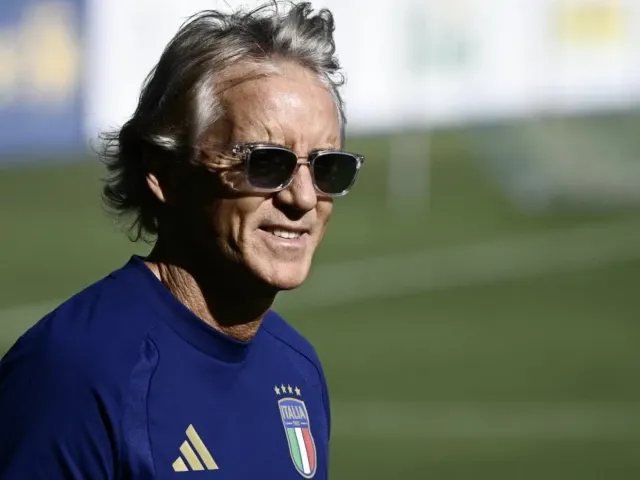
Italy’s footballing renaissance begins this Friday at the Stadio Olimpico, where Roberto Mancini will attempt to rewrite the nation’s recent history. The 67-year-old, who led Italy to Euro 2020 glory, has returned as head coach with a clear directive: end the World Cup drought that has haunted the Azzurri for three consecutive cycles. His first test against Belgium in the UEFA Nations League opener is not just a match—it’s a statement of intent after a qualifying campaign that left Italy’s hopes in tatters, eliminated by Bosnia and Herzegovina in March.
Mancini’s approach is one of calculated pragmatism. The squad he has assembled is a blend of battle-hardened veterans and raw talent, a deliberate strategy to balance experience with the fresh energy needed to compete at the highest level. The absence of a full-strength Italian team in international competition since that play-off defeat has created a vacuum, and Mancini is determined to fill it. His words on Monday—‘We have to take the national team back to where it deserves to be’—carry the weight of expectation, but also the humility of a coach who knows the road ahead will be arduous. The Nations League, while not a World Cup qualifier, is a critical litmus test. Belgium, a side that has consistently punched above its weight in recent years, will provide an immediate benchmark for Mancini’s project.
The tactical and psychological challenges are immense. Italy’s failure to qualify for the 2022 World Cup was not just a result of poor form but a symptom of deeper structural issues—lack of cohesion, defensive fragility, and a failure to adapt to modern football’s pace. Mancini’s revamped squad includes young players who have yet to prove themselves on the international stage, their development accelerated by necessity. The pressure is palpable, but so is the opportunity. For the first time in years, Italy has a coach who understands the nuances of modern football, having spent his career navigating the demands of elite competition. Whether he can translate that experience into tangible results remains the question.
Beyond the immediate matchup, Mancini’s tenure marks a turning point for Italian football. The calls for reform after the World Cup qualifying debacle were loud and persistent, and his appointment signals a shift toward a more competitive, forward-thinking approach. The Nations League opener is more than a game—it’s the first step in what could be a long journey back to relevance. Belgium, a team that has consistently delivered in recent years, will test Italy’s resolve. If Mancini can guide his side to a positive result, it will be a sign that the Azzurri are finally on the path to redemption. The stakes could not be higher.