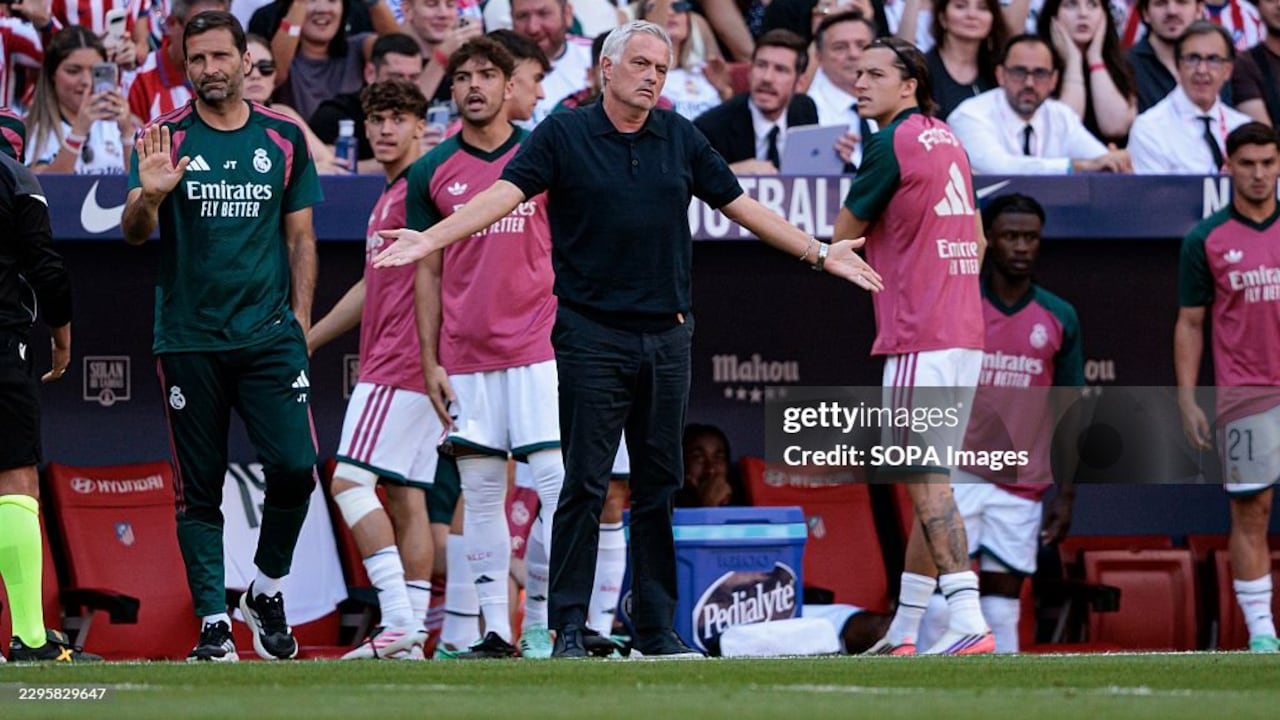
The La Liga presidency has delivered a withering critique of Real Madrid’s latest attempt to pin their derby defeat on refereeing bias, branding the club’s ‘conspiracy’ narrative as a thinly veiled excuse for their poor start to the season. Javier Tebas, the league’s president, responded directly to Madrid’s post-match claims—including manager José Mourinho’s presentation of screen-shots of alleged red-card-worthy tackles—by dismissing the entire argument as a distraction from the club’s evident tactical and performance shortcomings. ‘That narrative serves as an excuse to cover up other shortcomings that are plain to see in these first matches of the season,’ Tebas stated. ‘It’s more comfortable to point to a conspiracy than to explain what’s happening on the pitch.’ His words carry particular weight given Madrid’s history of invoking refereeing bias whenever results fail to align with expectations, a pattern Tebas described as ‘the permanent conspiracy’—one that he argues has become a reflexive fallback for the club’s leadership.
Tebas’s rebuke extends beyond mere semantics, challenging the very premise of Madrid’s accusations. He questioned whether the club genuinely believes referees operate under some unseen directive against them, or if the claims are instead a reflection of the pressure-cooker environment at Santiago Bernabéu. ‘Claiming that referees are directed against Real Madrid is living in another galaxy,’ he declared, before adding a pointed critique of the commercial implications: ‘What exactly is it asking for? Refereeing based on revenue, viewership, or the badge?’ His remarks underscore a broader tension in La Liga, where the league’s financial model—heavily reliant on the commercial might of its top clubs—often finds itself at odds with the principle of impartial officiating. Tebas’s insistence that ‘the competition belongs to no one’ was a direct rebuttal to Madrid’s suggestion that referees should somehow factor in the economic weight of clubs when making decisions, a proposition he called ‘a way to understand equality in the competition.’
The exchange between Tebas and Real Madrid’s camp is the latest escalation in a feud that has defined much of the league’s recent discourse. Madrid’s president, Florentino Pérez, has long been a vocal critic of La Liga’s governance, and Tebas’s remarks—delivered in response to a pro-Madrid media article—were framed as part of a broader narrative of institutional resistance. ‘Here they go again, the mouthpieces and the regime’s television, building the same old narrative,’ Tebas shot back, a dig that appears to target both the club’s media allies and the league’s perceived alignment with Madrid’s interests. The timing of his response, just days after the derby defeat, was deliberate: Tebas sought to reinforce the message that Madrid’s struggles are self-inflicted, not the result of external interference. His language was uncompromising: ‘It’s more comfortable to point to a conspiracy than to explain what’s happening on the pitch,’ a statement that carries the weight of a man who has presided over La Liga for years and seen Madrid’s cycles of dominance and decline.
Real Madrid’s official response to Tebas’s comments was swift and dismissive, calling his declarations ‘intolerable’ and implying that La Liga’s leadership is in need of reform. The club’s statement, issued on their website, framed the exchange as part of a larger power struggle, suggesting that the league’s governance is no longer fit for purpose. Yet Tebas’s intervention carries its own strategic weight. By refusing to engage with Madrid’s conspiracy theories, he has instead forced the club to confront the reality of their early-season form—a campaign that has seen them struggle against both traditional rivals and mid-table opponents. The derby defeat to Atletico Madrid, while controversial in its refereeing moments, was ultimately a result of Madrid’s inability to dictate play in the final third, a problem that Mourinho’s tactical adjustments have yet to fully resolve. Tebas’s critique, therefore, is not just about officiating; it is a challenge to Madrid to either accept responsibility for their performance or risk further alienating the league’s broader constituency.
What remains unclear is whether this latest exchange will escalate into a full-blown institutional conflict or if it will instead serve as a temporary distraction from the more pressing issue: Real Madrid’s ability to reclaim their footing in La Liga. Tebas’s remarks, while blunt, are rooted in a desire to maintain the integrity of the competition—a principle that has often been tested by Madrid’s influence. The club’s persistent reliance on the ‘conspiracy’ narrative, however, risks undermining the very credibility it seeks to protect. For now, the focus remains on the pitch, where Madrid’s next steps will determine whether their leadership’s rhetoric can match the results they demand. One thing is certain: the debate over refereeing impartiality in La Liga will not be silenced, and Tebas’s intervention has ensured it will continue to dominate the off-field conversation.