

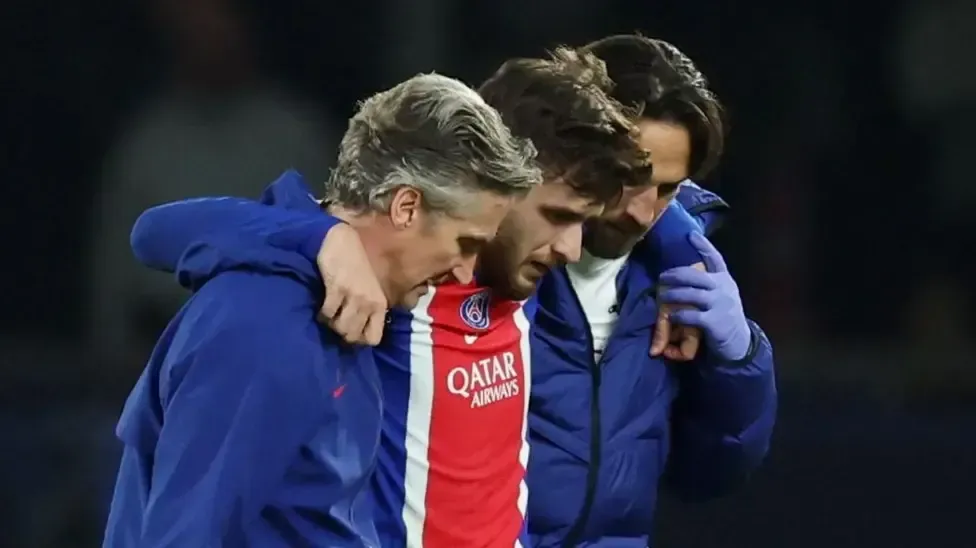
Paris Saint-Germain’s title defense has suffered a devastating blow with the confirmation that Khvicha Kvaratskhelia will undergo surgery to repair a ruptured anterior cruciate ligament (ACL) in his right knee. The Georgian winger, who played a pivotal role in PSG’s back-to-back Champions League victories, was forced off the pitch in the 59th minute of Tuesday’s 4-2 win over Barcelona at the Parc des Princes. His injury—suffered during a challenge with Barcelona’s Xavi Espart—was so severe that he could not put weight on his leg and was carried off the field by PSG’s medical staff.
The injury marks the latest setback for a PSG frontline already weakened by Ousmane Dembélé’s lingering thigh issue and Marquinhos’ own recent absence. Kvaratskhelia, who had made 11 appearances for PSG this season, was a dynamic force in midfield and on the right wing, providing both creativity and physicality. His absence now raises serious questions about PSG’s ability to maintain their defensive solidity and offensive firepower in the Champions League and Ligue 1. With such injuries typically requiring nine months of rehabilitation, his return to full fitness is unlikely before the 2027-28 campaign, effectively ending his season.
The timing of the injury could not be worse for PSG, who are chasing a historic third consecutive Champions League title. Kvaratskhelia’s departure from the field came in a game where Barcelona’s defensive organization was already under pressure, and his loss will leave a noticeable gap in PSG’s ability to press high and transition quickly. Espart, the Barcelona full-back who made contact with Kvaratskhelia, attempted to console the injured player as he left the pitch, a moment that underscored the gravity of the situation. PSG’s medical team has confirmed the surgery will take place in the coming days, but no timeline for recovery has been provided.
For Kvaratskhelia, this injury comes at a critical juncture in his career. The 25-year-old was named Champions League Player of the Season last campaign, a testament to his growth from a promising youngster at Napoli to a key player in one of Europe’s most dominant sides. His leadership and physicality were instrumental in PSG’s recent successes, and his absence will be felt acutely in both the team’s defensive structure and its attacking rhythm. While PSG’s squad depth remains a strength, the loss of Kvaratskhelia’s versatility—capable of operating as a winger, attacking midfielder, or even a false full-back—will force manager Luis Enrique to rethink his tactical approach in the immediate future.
The injury also raises broader questions about the physical demands of modern football, particularly in high-stakes matches where collisions and challenges are inevitable. Kvaratskhelia’s case highlights the fragility of even the most elite athletes, whose careers can be derailed by a single, unfortunate moment. For PSG fans, the news is a stark reminder that no team is immune to setbacks, and the pursuit of greatness often comes with the risk of injury. As the club prepares for their next Champions League fixture, the focus will now shift to managing the fallout of this injury and ensuring the remaining squad can adapt without Kvaratskhelia’s influence.



