

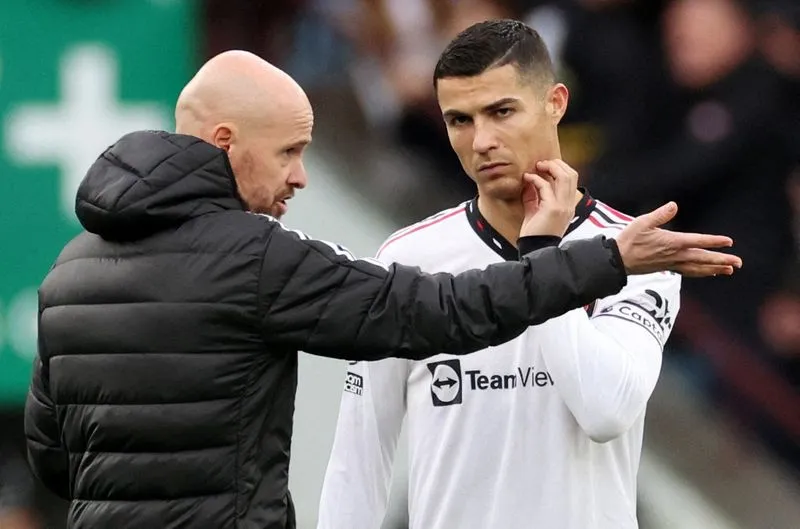
Erik ten Hag’s verdict on Cristiano Ronaldo’s second spell at Manchester United is a rare, unvarnished assessment of a player whose name alone once guaranteed success. ‘He let the team down, and he let me down,’ the Dutch manager declared, his words carrying the weight of a man who had once admired the Portugal international but was forced to confront a reality far removed from the hype. Ten Hag’s criticism isn’t about Ronaldo’s talent—it’s about his refusal to meet the demands of the modern game, a failure of discipline that eroded his own influence at a club desperate for consistency.
The evidence is damning in its simplicity. After a 4-0 humiliation at Brentford in October 2022, Ten Hag imposed a gruelling 13.8km run on the morning of the next training session—a standard he expected from every player. Ronaldo did not complete it. ‘He ran neither in possession nor out of possession,’ Ten Hag recalled, his frustration palpable. The manager’s direct confrontations—‘Ronnie, everyone wants to work for you to bring you in the right position, but if you can’t bring yourself in the box, you can’t score’—reveal a player who, despite his status, was unwilling to adapt. Ten Hag’s insistence that Ronaldo’s struggles were self-inflicted—‘The reason was because he didn’t prepare himself’—cuts through the narrative of external pressures, offering a stark contrast to the narrative of a man who once dominated with minimal effort.
The fallout was swift. By November 2022, United had terminated Ronaldo’s contract, a decision that followed a public rift with the club’s hierarchy and a scathing interview where the striker accused his employers of betrayal. Ten Hag’s sacking in 2024 only underscored the instability at Old Trafford, but his words now provide a rare, unfiltered perspective on the man who once wore the club’s colours with such reverence. The irony is bitter: a player who won three Premier League titles under Ferguson now stands accused of undermining a manager’s vision with his lack of commitment, a betrayal of the very principles that once made him untouchable.
Ronaldo’s departure marked the end of an era at United, but Ten Hag’s assessment extends beyond the club. The manager’s admission that he ‘had to make a rational decision and keep the players I admire in’ reveals a deeper truth about modern football: even legends must prove their worth daily. For Ronaldo, that proof was never delivered. His subsequent move to Al-Nassr, where he scored 14 goals in 16 games, suggests a player still capable of brilliance—but not under the scrutiny of a system demanding total commitment. The story of his second spell at United, then, is less about a decline in ability and more about a refusal to conform, a failure that cost him far more than just a trophy cabinet.



