

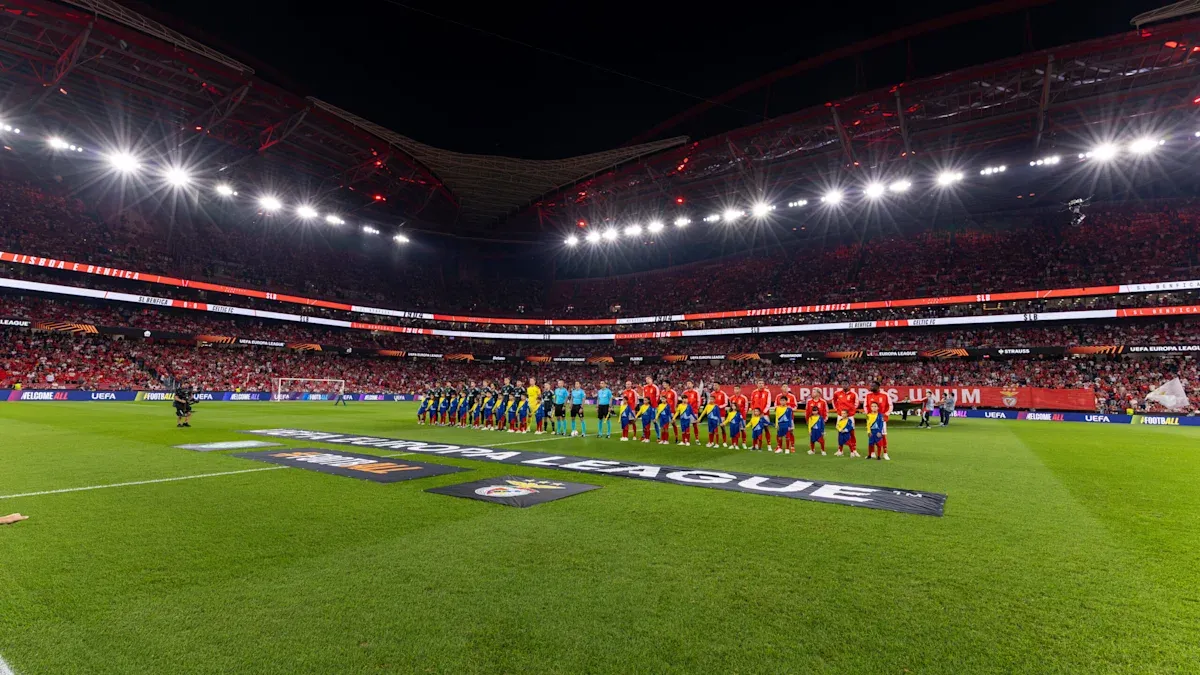
Celtic’s Europa League campaign took another devastating blow last night as Benfica sealed a 4-1 victory in Lisbon, a result that exposed not just tactical shortcomings but a deeper crisis of confidence under Martin O’Neill. The Hoops, returning to the city where they last lifted European silverware 61 years ago, were dominated in the first half, conceding three goals before the break—two from penalties and a third from Camilo Durán’s header. The defeat leaves Celtic third-bottom in the group, a position that risks eliminating them before their final fixture against Hearts.
The first half was a masterclass in Benfica’s clinical efficiency, but Celtic’s own creation was no less impressive. Five chances were generated, with Kasper Hogh and Camilo Durán both striking the woodwork in quick succession, while the team’s front three hit the frame three times in total. Yet none materialized, a stark contrast to the team’s attacking prowess in domestic competitions. O’Neill’s tactical adjustments at half-time—substituting Sebastian Tounekti for Callum Osmand and Oliver Sørensen for Benjamin Nygren—brought a fleeting spark. Hassan’s cross led to Durán’s equalizer, and the substitutions injected energy into midfield, with Nygren and Oxlade-Chamberlain stabilizing the center. But the damage was already done. The second half, while improved, was too little too late, as Benfica’s defense closed ranks and Pavlidis sealed the win.
O’Neill’s post-match press conference revealed a manager torn between pragmatism and frustration. ‘We created chance after chance and should have scored more goals,’ he admitted, acknowledging the team’s failure to capitalize. His praise for Hassan and Osmand—both of whom made an impact upon substitution—was tempered by the reality of the defeat. The Hoops’ struggles in European competitions this season have been well-documented: a 3-1 home loss to Ferencváros and a 4-1 collapse to LASK in the Champions League playoffs. Yet the Lisbon defeat carries particular weight, given Benfica’s form and their potential to win the Europa League. For Celtic, the stakes could not be higher—another early exit would further erode the belief that this team can compete at Europe’s second tier.
The tactical questions are now unavoidable. O’Neill’s system has struggled to adapt to the physicality of modern European football, where defensive lapses—like the early penalty conceded—can be punished with ruthless efficiency. The first-half collapse, where Celtic’s front three failed to exploit Benfica’s defensive shape, suggests a need for greater cohesion in attack. Meanwhile, the midfield’s inability to dictate tempo has been a recurring issue, with Nygren’s late arrival offering a glimpse of what could be. The challenge for O’Neill is whether he can instill the same European ruthlessness that defined Celtic’s golden era, or if this campaign will be remembered as another chapter in the team’s inconsistent European history.
With Hearts looming this Sunday, Celtic’s next test will be to prove they can turn this defeat into a turning point. O’Neill’s words of hope—‘We can still qualify’—ring hollow without tangible improvement. The Hoops’ ability to replicate their attacking firepower against domestic rivals will be critical. If Lisbon was a wake-up call, the coming weeks will determine whether Celtic can wake up—or if they’re destined to remain a team of potential, forever chasing the glory of their European past.



