

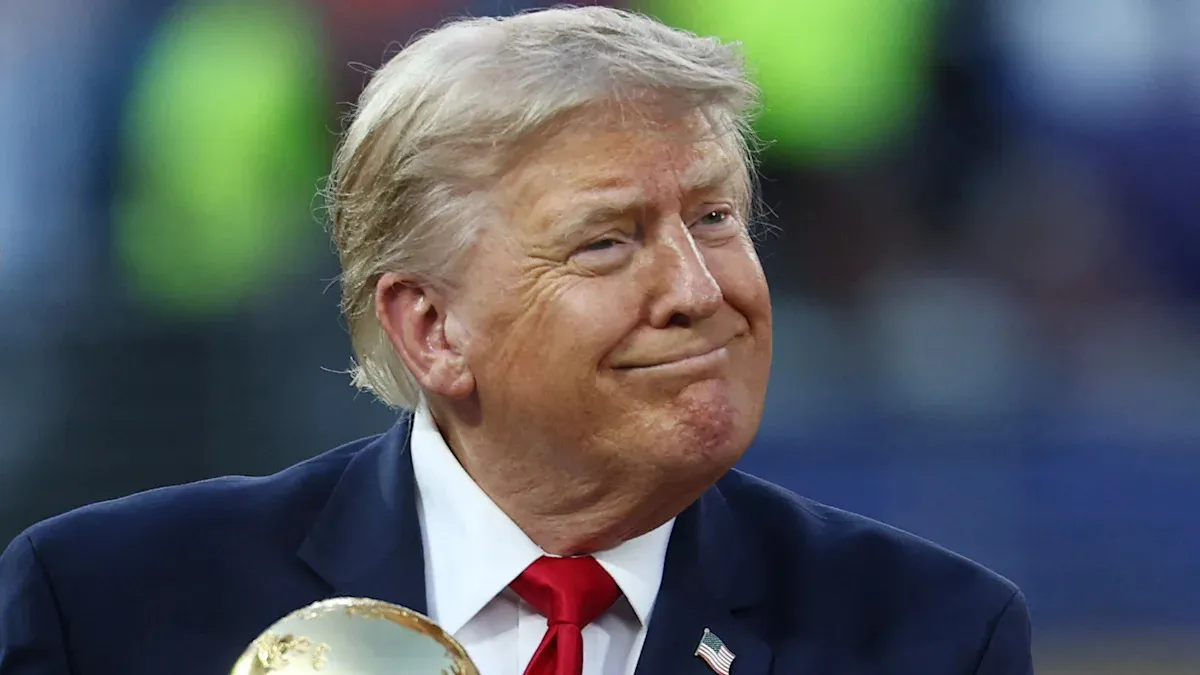
The World Cup final in East Rutherford was meant to be a triumph of global unity, but behind the scenes, FIFA’s relationship with Donald Trump exposed a governance model that prioritizes political favoritism over principle. When Trump took the stage to present the trophy to Rodri, the Spanish captain, FIFA’s official imagery omitted his presence entirely—a detail that suggests the organization’s discomfort with his involvement. The trophy ceremony, a moment of symbolic grandeur, became a spectacle of selective representation, with Trump’s role quietly edited out, likely to avoid further scrutiny of his controversial presence.
The chaos preceding the event was equally revealing. Journalists and media personnel faced hours-long delays, contradictory directions, and a logistical nightmare that undermined FIFA’s claims of professionalism. While fans navigated entry gates more smoothly, the media—essential to the event’s transparency—was treated as an afterthought. The disorganization wasn’t just ineptitude; it was a calculated response to the backlash Trump’s involvement had already sparked. Human rights organizations had long criticized FIFA for its silence on Trump’s policies, yet the organization doubled down, inventing a new ‘FIFA Peace Prize’ to flatter the president—a move that felt less like diplomacy and more like damage control.
The most damning revelation, however, was FIFA’s intervention in disciplinary matters. The suspension of United States striker Folarin Balogun was overturned after Trump intervened with FIFA President Gianni Infantino, a decision that raised serious questions about the organization’s independence. The reversal—made without public justification—underscored a pattern of FIFA bending to political pressure rather than upholding its own rules. The timing of the decision, coming so close to the World Cup final, suggests a deliberate effort to avoid controversy, but the damage to FIFA’s reputation was already done.
What remains unclear is whether this will be a turning point or a footnote in FIFA’s history. The organization has a long track record of self-preservation, but the cumulative effect of these decisions—from the trophy ceremony crop to the red-card reversal—paints a picture of an institution that has lost its moral compass. The World Cup was supposed to be a celebration of football’s universal appeal, but in the end, it became a case study in how power, politics, and poor governance can overshadow the game itself.



