

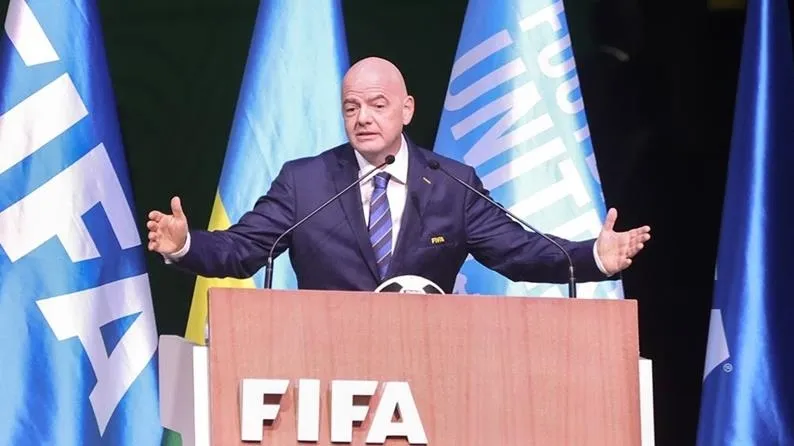
Gianni Infantino’s tenure as FIFA president has reached a breaking point. New financial disclosures reveal that in 2024, the Swiss leader received an additional £1.3 million from FWC2026—the company overseeing the 2026 World Cup—on top of his already substantial £3.88 million salary. The payment, which was not disclosed in FIFA’s official financial reports, violates Article 43, paragraph 13 of the organization’s statutes, which mandates full transparency for the president’s compensation. This is not merely a matter of accounting irregularity; it is a direct violation of FIFA’s own rules, compounding a series of controversies that have eroded trust in the governing body’s leadership.
The revelation comes at a critical juncture for FIFA. Infantino has repeatedly defended his controversial plan to privatize key aspects of world football, including the World Cup, through FIFA Forward Enterprise (FFE). Valued at an estimated $20 billion, the initiative would allow FIFA to sell a minority stake—up to 20%—to private investors, potentially generating billions in revenue. Yet the proposal has faced unanimous opposition from UEFA, which has threatened to boycott FIFA competitions if the plan proceeds. CONCACAF and the Asian Football Confederation have also voiced strong objections, while Norway’s soccer federation has explicitly called for Infantino’s resignation, declaring that ‘there is no trust in Infantino now.’ The message is clear: the leadership’s credibility is in freefall.
The financial irregularity alone would be enough to provoke a crisis, but it is the broader context that makes this moment particularly dangerous for Infantino. His senior advisor, Carlos Cordeiro, resigned in protest, calling the privatization plans a ‘bad deal for football.’ Meanwhile, FIFA’s own management board has publicly reaffirmed its support for Infantino, though the optics of such loyalty are increasingly strained. The UK Prime Minister, Andy Burnham, has joined the chorus, publicly urging Infantino to step down. With his re-election campaign set for March 2027, the president now faces not just a credibility gap but a full-blown legitimacy crisis—one that could fracture FIFA’s global coalition of member associations.
The implications stretch far beyond personal accountability. The privatization debate touches on the very soul of world football: whether the sport should remain a democratic, member-driven organization or become a commercial enterprise subject to market forces. Infantino’s defenders argue that such reforms are necessary to secure football’s financial future, but critics warn that selling off the World Cup—football’s most sacred tournament—could dilute its integrity. The boycott threats from UEFA and other confederations are not empty rhetoric; they represent a direct challenge to FIFA’s authority. If the governing body cannot enforce its own transparency rules or reconcile its leadership with its member associations, the consequences could be irreversible. For now, Infantino’s future hangs by a thread—one that may unravel long before his next term begins.



