

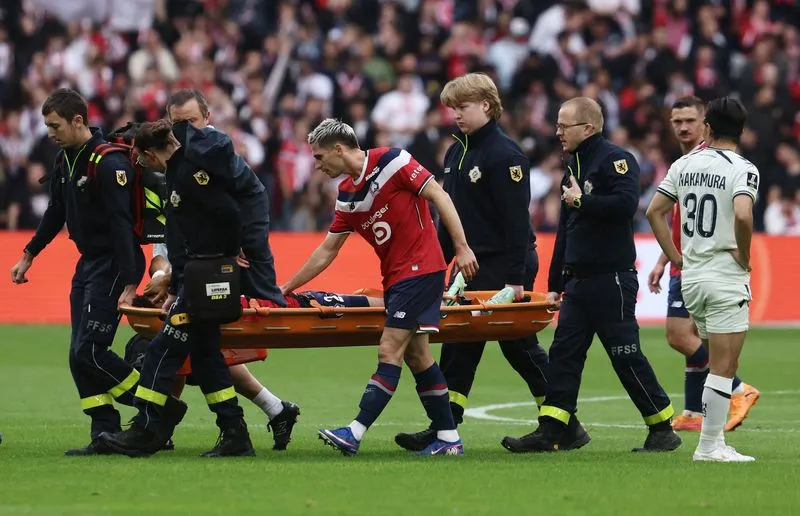
Lille’s pursuit of justice against Le Havre has escalated to a potential legal battle following Tiago Santos’ season-ending ACL rupture in a Ligue 1 clash on Saturday. The 24-year-old Portugal U21 defender, already sidelined for months after a similar injury to his left knee in October 2024, was carried off on a stretcher after a first-half tackle by Le Havre midfielder Amir Richardson. The challenge—deemed a foul but met with no disciplinary action—has left Lille questioning the integrity of the refereeing process, with the club now demanding an explanation from the Ligue de Football Professionnel (LFP) and the French Football Federation (FFF).
The incident occurred in a 1-0 victory for Lille, a team currently second in Ligue 1 and poised to face Arsenal in the Champions League on Tuesday. Santos, who had started every Ligue 1 match for Lille this season, was tackled in a manner Lille has described as ‘uncontrolled and dangerous,’ a description that aligns with the severity of his injury—a ruptured ACL combined with a meniscal tear. The absence of any caution or red card for Richardson, despite the tackle’s apparent severity, has fueled Lille’s frustration. The club has explicitly requested the LFP to refer the matter to its disciplinary panel, arguing that the tackle warranted a direct dismissal under the rules. Their demand for clarity on the Video Assistant Referee’s (VAR) review process underscores the growing skepticism over the handling of such incidents in modern football.
Lille’s statement leaves no room for ambiguity: the club is ‘exploring all possible legal avenues’ and reserves the right to pursue compensation for the damages incurred. This is not merely a tactical or disciplinary issue but a matter of player welfare and institutional accountability. Santos’ second ACL injury in less than two years—both sustained in tackles—highlights the physical toll such challenges can exact on defenders, particularly those at the peak of their careers. Lille’s decision to support Santos in any potential legal recourse reflects both the personal stakes for the player and the broader implications for player safety in professional football.
Le Havre, while expressing sympathy for Santos’ recovery, has defended the refereeing decision, asserting that neither the on-field referee nor VAR deemed the tackle punishable. The club’s response underscores a fundamental tension in football’s disciplinary framework: the subjective nature of VAR reviews and the limited scope for post-match sanctions. For Lille, however, the issue transcends semantics. The club’s willingness to escalate the matter legally signals a shift in how clubs may increasingly challenge perceived failures in match officiating, particularly when player health is at risk. With Santos’ rehabilitation likely to span several months, the incident also casts a shadow over Lille’s Champions League fixture against Arsenal, where his absence will be keenly felt in both defense and morale.
The fallout from this incident could redefine how Ligue 1 and the FFF address player safety in tackles, particularly those involving high-impact challenges. For now, Lille’s focus remains on securing justice for Santos while navigating the immediate challenges of a Champions League campaign without their captain. The case serves as a stark reminder that in an era where VAR is intended to enhance fairness, the human element—both on and off the field—often remains the most unpredictable variable.



