

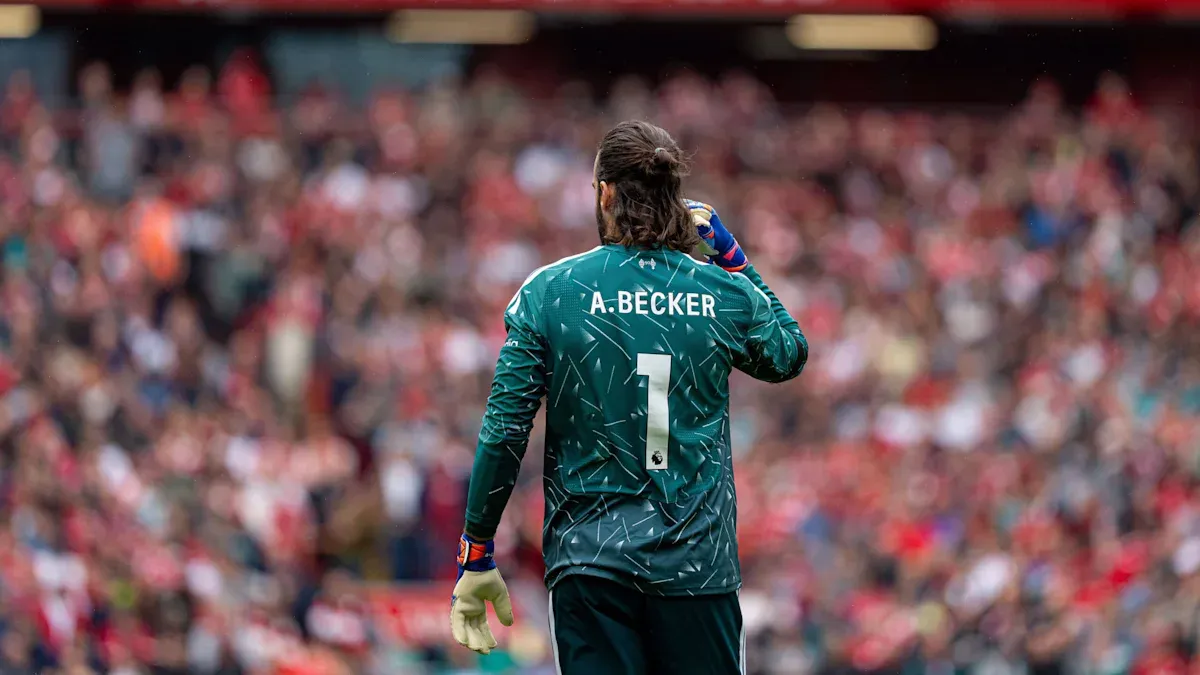
Liverpool’s goalkeeper situation has reached a defining moment. Alisson Becker’s contract, which was extended through the 2026-27 season via an option clause earlier this year, now stands as the sole barrier between him and a free transfer. The Brazilian’s role at the heart of Liverpool’s defense remains unassailable—his reflexes, distribution, and leadership have been the bedrock of Jurgen Klopp’s system and, increasingly, Andoni Iraola’s rebuild. Yet the absence of active negotiations for a new deal signals a shift in the club’s thinking. Liverpool’s hierarchy must now weigh the value of continuity against the strategic imperative to plan for the future, particularly as younger alternatives emerge in the ranks.
The decision is not merely about Alisson’s tenure; it is about the club’s vision for its future. Liverpool’s recent history has been marked by high-profile departures—Mohamed Salah, Andy Robertson, and Virgil van Dijk among them—each departure reshaping the squad’s dynamics. The activation of the extension clause in Alisson’s contract was a deliberate move to avoid losing another key figure during the summer transfer window. But with his current deal set to expire in June 2027 and no further extension options embedded, the club faces a binary choice: either secure his services with a new contract or prepare for his departure as a free agent. The timing of this decision is critical. Fabrizio Romano’s assessment—that ‘there could be movements in summer 2027’—highlights the uncertainty, but also the inevitability of a resolution. The question is whether Liverpool will extend the contract or begin planning for a transition that could see Alisson leave Anfield.
Alisson’s own trajectory adds another layer of complexity. His performances remain world-class, and his influence on the team extends beyond statistics. Yet age—he turns 35 in January—and recent injury concerns, particularly hamstring issues, have introduced variables that could influence the club’s calculus. The presence of younger alternatives, though not yet proven at the first-team level, suggests Liverpool is evaluating its long-term goalkeeping structure. The arrival of Mamardashvili, while promising, has not yet translated into consistent first-team minutes, leaving Alisson as the undisputed leader between the posts. This duality—his irreplaceable status now versus the need for a successor—creates a tension that will define the coming season.
The stakes could not be higher. Allowing Alisson to leave without a new deal would represent a strategic misstep, given his impact on Liverpool’s defensive organization and his ability to elevate the performance of those around him. His departure would not only create an immediate void but also signal a broader shift in the club’s approach to leadership and experience. Conversely, retaining him would require a contract that reflects his market value, a decision that could tie up significant resources at a time when Liverpool’s financial strategy is under scrutiny. The club’s ability to balance these competing priorities will determine whether Anfield’s defensive identity remains unshaken or undergoes a transformation that could redefine the Reds’ competitive trajectory in the years ahead.
For now, the decision remains in limbo. No active talks have been reported, and the club’s silence speaks volumes about the deliberation underway. The summer of 2027 looms as the deadline, but the real question is whether Liverpool will act decisively now—or risk the uncertainty of a last-minute scramble to retain a goalkeeper whose legacy at the club is already cemented in history.



