

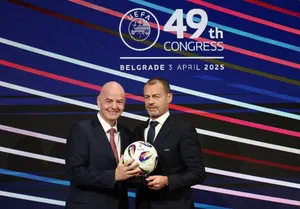
The clock is ticking for Gianni Infantino. As European soccer’s governing bodies gather in Berlin for an emergency summit, the pressure to unseat FIFA’s president has never been more acute. The meeting, convened by UEFA under urgent circumstances, arrives just weeks after Infantino’s World Cup privatization proposal collapsed in public outrage, exposing deep fractures within the global game’s leadership. The plan—revealed in July and abandoned within days—was the latest in a series of controversial moves that have alienated key confederations, including UEFA’s allies in Asia and North America.
The summit’s primary objective is clear: to identify a single, credible candidate capable of uniting Europe’s 55 member federations behind a unified challenge. UEFA President Aleksander Ceferin, who has led the charge against Infantino’s leadership, is not on the ballot himself, but his influence remains decisive. Neither Sheikh Salman bin Ebrahim Al Khalifa of the AFC nor Victor Montagliani of CONCACAF—both vocal critics of Infantino’s governance—appear positioned to lead the charge either, leaving European soccer to take the helm. The absence of a pre-approved successor has forced UEFA to act with unprecedented haste, as the FIFA presidential election looms closer.
Infantino’s response to the crisis has been defensive. In a rare concession, he has proposed an independent review of FIFA’s decision-making—a move that could either restore trust or be seen as a desperate attempt to buy time. Yet the damage is already done. The World Cup privatization plan, which sought to inject private investment into the tournament’s infrastructure, was met with near-universal condemnation. Even within FIFA’s own ranks, the proposal was dismissed as a reckless gamble that threatened the sport’s financial stability. The fallout has emboldened UEFA’s leadership, which now views the Berlin summit as a last opportunity to consolidate support before the election.
The stakes extend beyond FIFA’s boardroom. A leadership change would reshape the global game’s priorities, potentially redirecting resources toward grassroots development, anti-corruption reforms, and a more transparent governance model. For UEFA, the urgency is twofold: to prevent Infantino from consolidating power further and to ensure Europe’s voice remains dominant in FIFA’s future. The summit’s outcome will not only determine the next president but also the direction of soccer itself—deciding whether the sport will embrace reform or double down on the divisive policies that have defined Infantino’s tenure.
What happens in Berlin this week will be remembered as a defining moment. The European federations have a narrow window to present a cohesive alternative, one that can appeal to the broader international soccer community. Failure to act decisively risks prolonging the crisis, while success could mark the beginning of a new era—one where FIFA’s leadership is no longer defined by controversy, but by unity and progress.



