

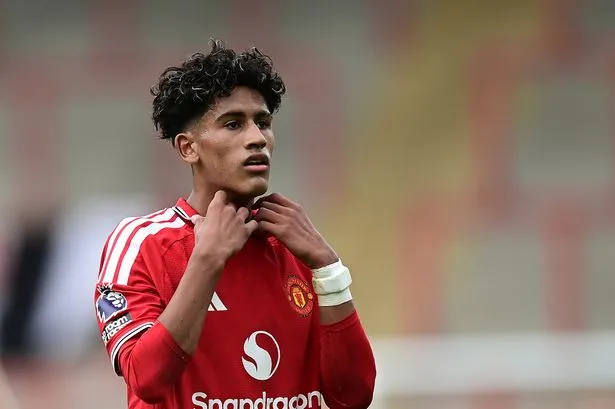
Manchester United’s return to Premier League action is overshadowed by a far more pressing issue: the unresolved saga of JJ Gabriel. The 16-year-old winger, who signed a five-year deal with the club in 2022, has made it clear he will not train or compete unless his demands are met. His representatives have formally requested the cancellation of his registration to become a free agent—a move United has thus far rejected outright. The impasse is no longer just about playing time; it’s about the teenager’s refusal to commit to the club’s long-term vision, a stance that risks turning him into a liability rather than an asset.
The core of the dispute lies in Gabriel’s insistence on a scholarship contract, a structure that would grant him greater financial autonomy and flexibility. His family has also demanded he be granted at least 20 minutes of playing time in key fixtures—against Sabah in the Champions League, Brighton in the FA Cup, and Bournemouth in the Premier League—before any contract negotiations can proceed. The logic is simple: without proof of trust and opportunity, Gabriel sees no reason to extend his stay. Yet United’s refusal to budge signals a deeper tension. The club has long relied on its youth academy as a pipeline for talent, but Gabriel’s demands threaten to expose the fragility of that system when ambition clashes with institutional inertia.
The stakes could not be higher. At 16, Gabriel is at an age where development should be the priority, yet his public stance—couched in interviews and behind-the-scenes negotiations—has already painted him as a player who values immediate rewards over patience. Analysts who have followed his career from the outset warned this moment was inevitable. ‘There was always going to be this problem,’ one insider remarked, noting how a teenager signing at 16, with a contract extending to 21, would inevitably face a reckoning when he reached adulthood. The question now is whether United can afford to lose him without a fight—or if they’ve already lost the battle for his loyalty.
For now, the club is playing a waiting game. The international break has provided a temporary reprieve, but the return to competitive football will force United to confront Gabriel’s absence. His refusal to train or play has already drawn scrutiny, with some questioning whether his departure is merely a matter of time. The Glazer ownership’s handling of the situation—marked by silence and steadfast refusal to accommodate the teenager’s demands—has only hardened Gabriel’s resolve. The reality check he’s receiving is not just about football; it’s about the cost of ambition versus the realities of a club’s priorities. And with each passing day, the window to resolve this quietly narrows.



