

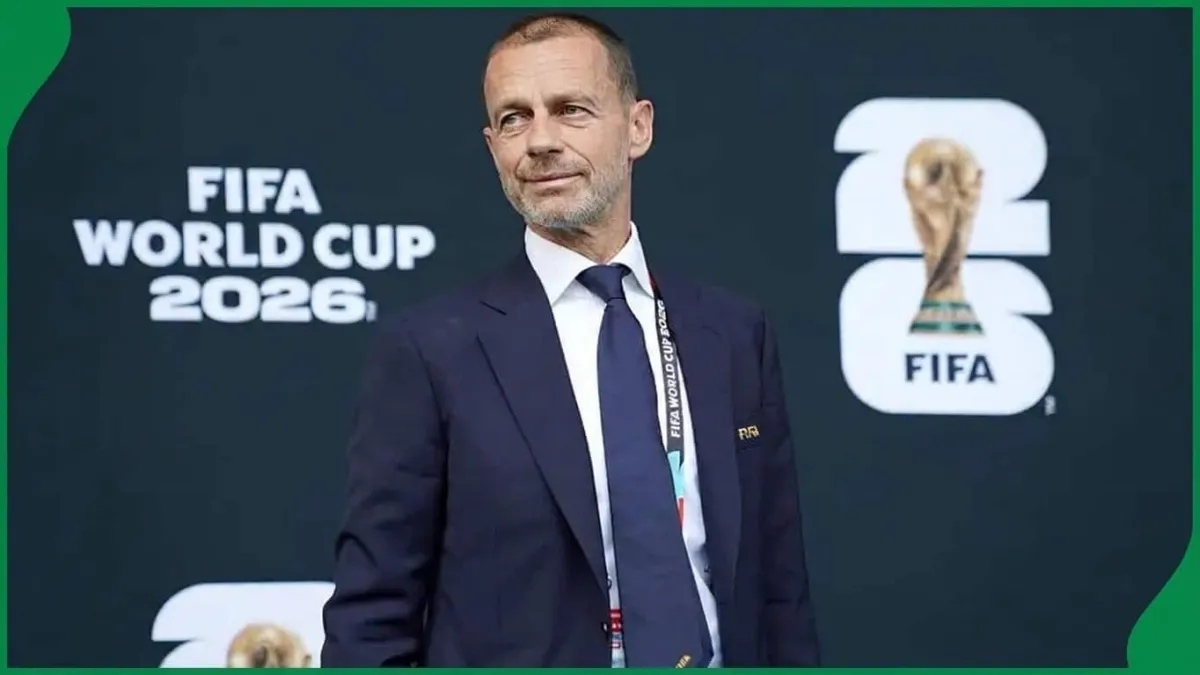
Aleksander Ceferin has confirmed his candidacy for a fourth consecutive term as UEFA president, a move that underscores both his personal ambition and the deepening fractures within European football’s relationship with FIFA. The announcement follows a series of high-profile confrontations, most recently the controversial handling of Folarin Balogun’s suspension during the 2026 World Cup, which Ceferin chose to boycott entirely, signaling a complete breakdown in diplomatic ties with FIFA president Gianni Infantino. His decision to stand again—despite the escalating tensions—suggests a calculated gamble: that UEFA’s institutional stability outweighs the risks of further isolation from the global game’s governing body.
Ceferin’s stance is not merely political; it is tactical. In a direct challenge to Infantino’s leadership, he has framed the issue not as a personal vendetta but as a matter of principle. ‘One option is that he realizes he doesn’t have the support—not just from voters, but from the football community, fans, players, former players, and coaches,’ Ceferin stated in a recent interview, laying bare the breadth of dissatisfaction with FIFA’s direction. The implication is clear: Infantino’s authority is eroding, and UEFA—under Ceferin’s leadership—is positioning itself as the voice of reform. Yet Ceferin’s own bid for re-election risks complicating this narrative. By seeking another term, he risks appearing as part of the status quo rather than the catalyst for change.
The European front is hardening. At a recent UEFA Executive Committee meeting in Thessaloniki, Greek Football Association president Makis Gagatsis and former Germany national team director Oliver Bierhoff publicly backed Ceferin’s push for accountability at FIFA, signaling that UEFA’s unity on this issue is unshaken. The meeting’s symbolic gestures—including a grassroots football festival—highlighted UEFA’s commitment to grassroots development, a contrast to FIFA’s recent controversies over governance and player welfare. Yet the real test lies in March, when Infantino’s leadership will face its first direct challenge in years. Ceferin has made it clear he will not run against Infantino personally, but his refusal to endorse a unified European candidate—while standing for his own term—suggests a strategy of indirect pressure. If Infantino persists, Ceferin’s warning carries weight: the football community, from the pitch to the boardroom, is no longer willing to tolerate leadership without legitimacy.
The implications stretch far beyond UEFA’s borders. A divided global football governance structure risks undermining the integrity of competitions like the World Cup, where trust between confederations and FIFA is foundational. Ceferin’s decision to prioritize his own tenure over a broader reform agenda—even as he criticizes Infantino’s—could further polarize the sport. Yet his insistence on ‘enjoying life a bit’ after decades in leadership hints at a deeper tension: the man who has steered UEFA through its most turbulent era may now be out of sync with the urgency of the moment. The next 12 months will determine whether his fourth term is a bridge to reform or a final chapter in an era of football’s governance crisis.



