

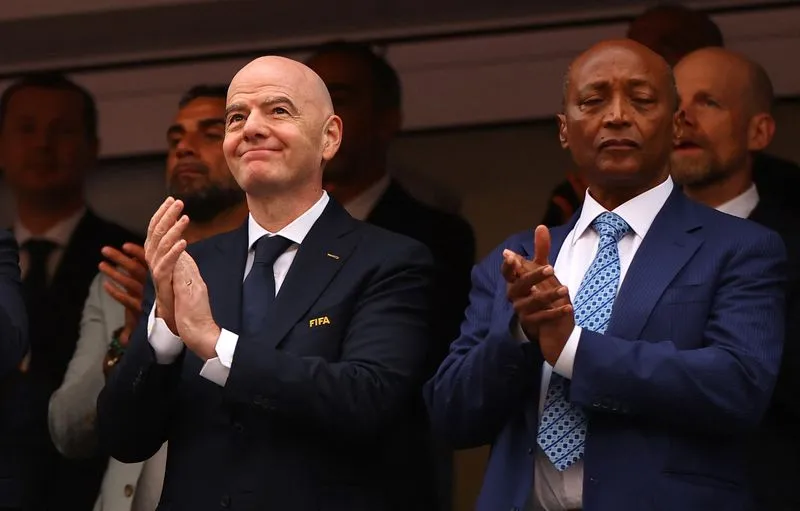
Gianni Infantino has cemented his path to a second term as FIFA president by securing the unconditional backing of every single African football association, a bloc of 54 nations that collectively hold immense voting power in the upcoming March election. The pledge, announced at a landmark strategy symposium in Cape Verde—a first-of-its-kind gathering of CAF presidents—represents a turning point in the contest, where European and North American support for the Swiss leader has eroded following his shelved proposal to sell a stake in FIFA tournaments. CAF President Patrice Motsepe made the decision explicit: ‘There is a unanimous decision by the 54 CAF member associations to unconditionally support Gianni as president of FIFA.’ The statement, delivered to delegates in Cape Verde, underscores the depth of Infantino’s influence on the continent, where his tenure has been marked by tangible investments—$1 billion allocated through FIFA Forward over a decade, funding 124 projects across Africa.
The timing of this solidarity is strategic. With former Switzerland defender Ramon Vega now a declared challenger and UEFA President Aleksander Ceferin’s bid for a second term effectively removing a high-profile European rival, Infantino’s campaign has pivoted to consolidating his base. The Cape Verde conference served as a direct platform to engage with over a quarter of FIFA’s 211 voters, allowing Infantino to frame his leadership as one of sustained partnership rather than ideological division. ‘When concerns are raised, we address them with open arms,’ he told delegates, a deliberate contrast to the confrontational tone that has alienated some European and North American federations. His emphasis on dialogue—coupled with the recent World Cup’s historic ten African qualifiers—positions his reelection as a continuation of Africa’s upward trajectory, not a departure from it.
Yet the financial figures tell their own story. Infantino’s reference to ‘this revolution in African football’ over the past decade is not hyperbole: the $1 billion commitment, spread across 124 initiatives, reflects a deliberate strategy to elevate the continent’s profile. His remarks about ‘increasing resources’ and ‘boosting the African game to the top of world football’ resonate with CAF’s long-standing allyship, but they also signal a counter-narrative to critics who argue FIFA’s governance reforms have fallen short. The absence of direct mention of the stalled tournament stake sale—once a flashpoint—suggests Infantino is steering the conversation toward shared goals rather than institutional disputes. ‘It is up to you as CAF to tell us what you want,’ he said, a subtle acknowledgment that FIFA’s future depends on Africa’s priorities, not just its votes.
The dynamics of the election are now clearer: Infantino’s campaign will hinge on the African bloc’s cohesion, while Vega’s bid—though ambitious—lacks the same geographic depth. The withdrawal of key European and North American supporters has left Infantino vulnerable, but the Cape Verde declaration neutralizes that risk. For CAF, the decision is as much about legacy as it is about leadership. Veron Mosengo-Omba, the newly elected head of the DR Congo Football Federation, went so far as to declare his personal loyalty, stating he would ‘take a bullet’ for Infantino—a rare public display of allegiance in football governance. Whether this translates into a mandate at the ballot box remains to be seen, but the African bloc’s unified stance has already reshaped the contest, making Infantino’s reelection a plausible outcome if not a certainty.



