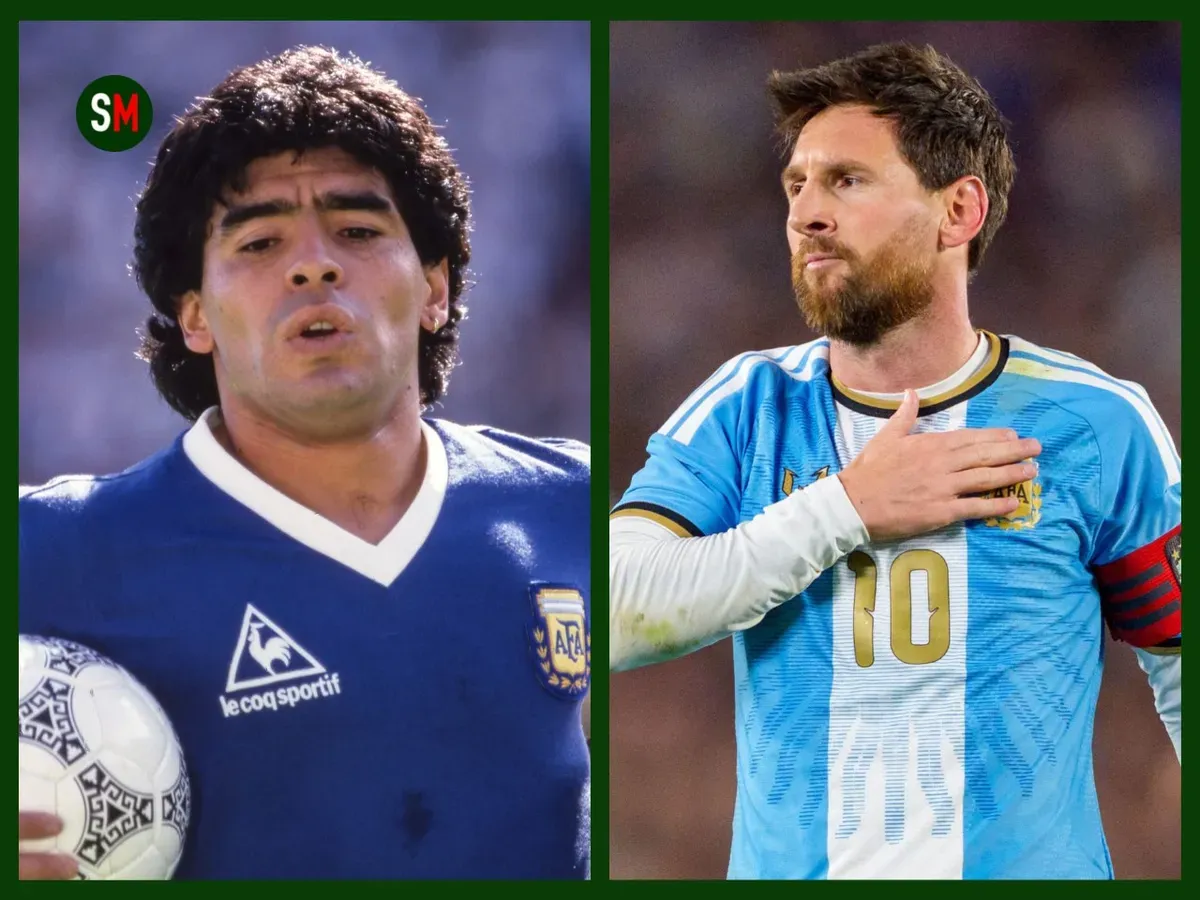
The comparison between Lionel Messi and Diego Maradona has been the most enduring debate in Argentine football history. For decades, pundits and fans have dissected every dribble, every goal, every moment of genius to determine which of the two was the greater. But numbers, as they often do, have the final word—and they are not kind to Maradona’s legacy when measured against Messi’s.
Maradona’s career totals are undeniably impressive: 34 goals for Argentina, a World Cup-winning trophy in 1986, and the kind of individual brilliance that still defines the tournament’s greatest moments. Yet Messi’s numbers tell a different story. Since his 35th birthday—an age when most players are winding down—he has scored 34 goals alone. That is not a comparison; it is a dismantling. His 18 World Cup goals eclipse Maradona’s eight, and his 120 international goals dwarf the 34 the Argentine icon managed in his entire career. The gap is not just in quantity but in longevity: Messi’s dominance spans two decades, while Maradona’s peak was confined to a single, unforgettable tournament.
The 2026 World Cup has only accelerated this narrative. Messi’s assist record—now tied at nine, a feat he achieved in a single match—is a milestone that Maradona never approached. His nine-game World Cup scoring streak is the longest in history, a testament to a player who has not just aged but refined his craft. Meanwhile, Argentina’s 2026 campaign has already rewritten their own history: five consecutive wins at a World Cup, a record tied only with their 2014 run, and eight goals scored from the 76th minute onward—a statistic that speaks to Messi’s ability to elevate his team in the most critical moments. The numbers do not lie: Messi’s impact on Argentina’s success is not just comparable to Maradona’s but exponentially greater in scale and consistency.
Even in the most scrutinized moments—those where VAR has overturned decisions—Argentina’s 2026 campaign has been a masterclass in resilience. They are the only team to have two goals disallowed by the technology in this tournament, yet their ability to bounce back, to dominate late in games, is a hallmark of Messi’s leadership. His third career World Cup knockout-stage game with at least one goal and one assist—tied with Thomas Müller for the most since 2006—underscores his ability to perform when it matters most. Maradona’s 1986 World Cup remains the gold standard for individual brilliance, but Messi’s career is defined by a different kind of greatness: sustained excellence, record-breaking consistency, and a legacy that transcends a single tournament.
The debate is no longer whether Messi is better than Maradona. The question now is how much greater. The numbers do not just favor Messi—they obliterate any remaining doubt. In the grand tapestry of Argentine football, Messi’s name will be written in ink, while Maradona’s remains etched in legend. But it is the numbers that ensure the latter’s place in history is forever overshadowed by the former’s.