

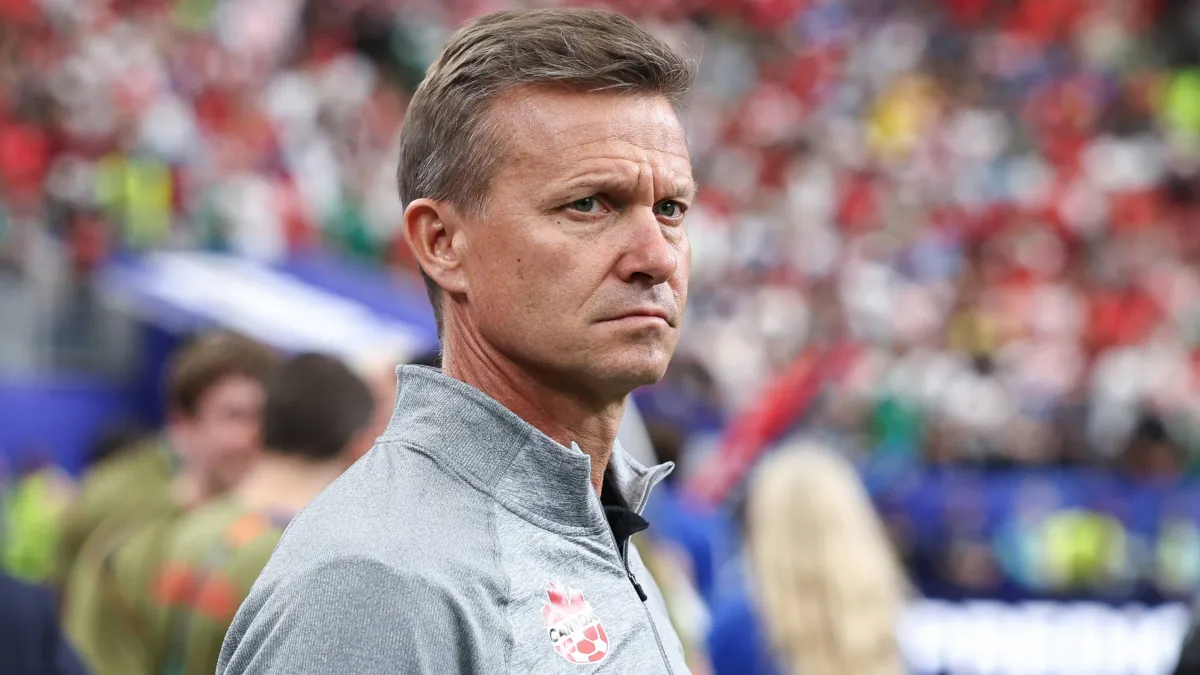
Jesse Marsch has spent a career as a man who speaks his mind, and his latest outburst against the United States is no exception. The USMNT’s struggles at this World Cup—particularly the chaotic handling of Folarin Balogun’s suspension—have provided the Canadian manager with a platform to lay bare what he sees as the root of American football’s global reputation. ‘This is why everyone around the world hates America,’ he declared, framing the Balogun controversy as symptomatic of a broader entitlement problem that plagues the sport in the United States.
Marsch’s criticism isn’t new. He has long been a vocal critic of former President Trump’s rhetoric, particularly his dismissal of Canada as the ‘51st state,’ a remark that stung given Marsch’s dual identity as a Canadian citizen and a product of American football culture. His loyalty now lies with Canada, where his leadership has transformed the national team’s identity—from a niche curiosity to a legitimate World Cup contender. The historic last-16 run against South Africa didn’t just mark a tactical triumph; it signaled a cultural shift. ‘Canadian heroes,’ fans chanted in the aftermath, a phrase that encapsulates how the team’s progress has reshaped perceptions of the sport in the country. ‘It is starting to become known as football now, not soccer,’ one supporter told BBC Sport before the match, highlighting how Marsch’s project has accelerated the sport’s evolution in Canada.
Yet Marsch’s frustration extends beyond national pride. His scathing remarks about the treatment of Canadian players—including Ismael Kone’s alleged mistreatment under Roberto De Zerbi at Tottenham—expose a deeper issue: the lack of reciprocity in how American football engages with the global game. The Balogun saga, where the USMNT’s disciplinary process was widely criticized for its perceived arbitrariness, became a microcosm of this disconnect. Marsch’s bluntness isn’t performative; it’s a reflection of his belief that American football’s cultural footprint—despite its commercial dominance—often clashes with the values of the rest of the world. ‘No U.S. President would support Everton,’ he implied, a jab at the political and economic disparities that shape how the sport is perceived internationally.
The implications of Marsch’s words are significant. For a country still grappling with its place in global football, his candidness forces a reckoning. The USMNT’s next steps—whether in the upcoming knockout stages or in the long-term development of its players—will determine whether the sport can bridge the gap between its domestic culture and the international expectations that come with its status as a footballing giant. Marsch’s role in this debate is clear: he won’t back down, and neither will the issues he’s highlighting. The question now is whether the American game will listen—or if it will continue to be defined by the very entitlement that mars its reputation abroad.



