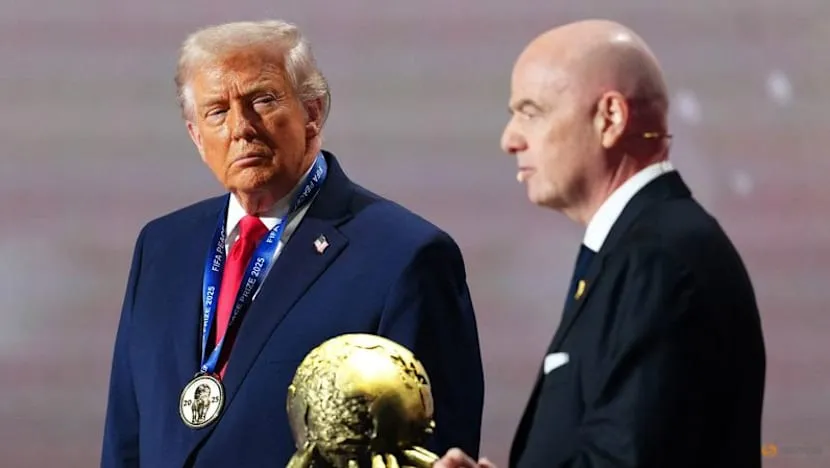
The World Cup is football’s most sacred event, a spectacle that transcends sport, politics, and culture.
Yet in the shadows of its glory, a proposal emerged that could have reshaped its very essence—one that threatened to turn the tournament into a commercial commodity rather than a global celebration.
Without the relentless pursuit of verified information, the football world might have stumbled into this reckoning blindly.
That such a radical idea—selling the World Cup—was ever considered at all is a testament to the power of journalism in holding power to account.
Gianni Infantino, then and now FIFA president, once floated this proposal in private discussions, a move that would have redefined the tournament’s financial and ethical foundations.
The idea, if implemented, could have prioritized profit over passion, turning the quadrennial event into a transaction rather than a unifying force.
Yet it was not the voices of the public or even the most vocal critics that exposed this potential betrayal.
Instead, it was the work of professional journalists—those who dedicate their careers to uncovering the truth—that ensured the world learned of this proposal before it became irreversible.
Stig Ørskov, CEO of the World Association of News Publishers, has emphasized that without such journalism, the football community would have remained in the dark, its most cherished event at risk of being hijacked by short-term financial gain.
The stakes were never higher.
Football’s governing bodies operate in an environment where transparency is often the first casualty of ambition.
The World Cup is not just a competition; it is a cultural phenomenon, a moment where nations pause to unite under the banner of sport.
To suggest selling it—to treat it as a product to be bought and sold—would have been to betray the very spirit that makes it extraordinary.
Yet this was not a fringe idea.
It was discussed at the highest levels, where the weight of tradition and the allure of profit collide.
The fact that such a proposal existed at all speaks to the fragility of football’s ethical guardrails, a vulnerability that only rigorous journalism could expose.
Orskov’s perspective underscores a broader truth: journalism is not merely a service; it is a safeguard.
In an era where misinformation spreads faster than the ball in a final, the role of verified reporting becomes indispensable.
Lies can be manufactured in moments, but the best obtainable version of the truth requires time, talent, resources, and courage.
The World Cup proposal was not just a financial gambit; it was a test of football’s integrity.
That it was exposed before it could take root was not luck, but the result of a media landscape that refuses to let power operate in the dark.
Football’s controversies are as old as the game itself, from match-fixing to political interference.
Yet each scandal, each ethical breach, reveals the same truth: without journalism, the game would be unrecognizable.
The World Cup’s near-miss with commercialization is a reminder that the most powerful institutions need the most vigilant watchdogs.
The football world owes its purity to those who dare to ask the difficult questions—and to those who answer them with facts, not fiction.